

St. John Henry Newman: Independent Thinker, Intellectual Giant, Saint for Our Times
“Strive for peace with everyone, and for that holiness without which no one will see the Lord,” (Hebrews 12:14).
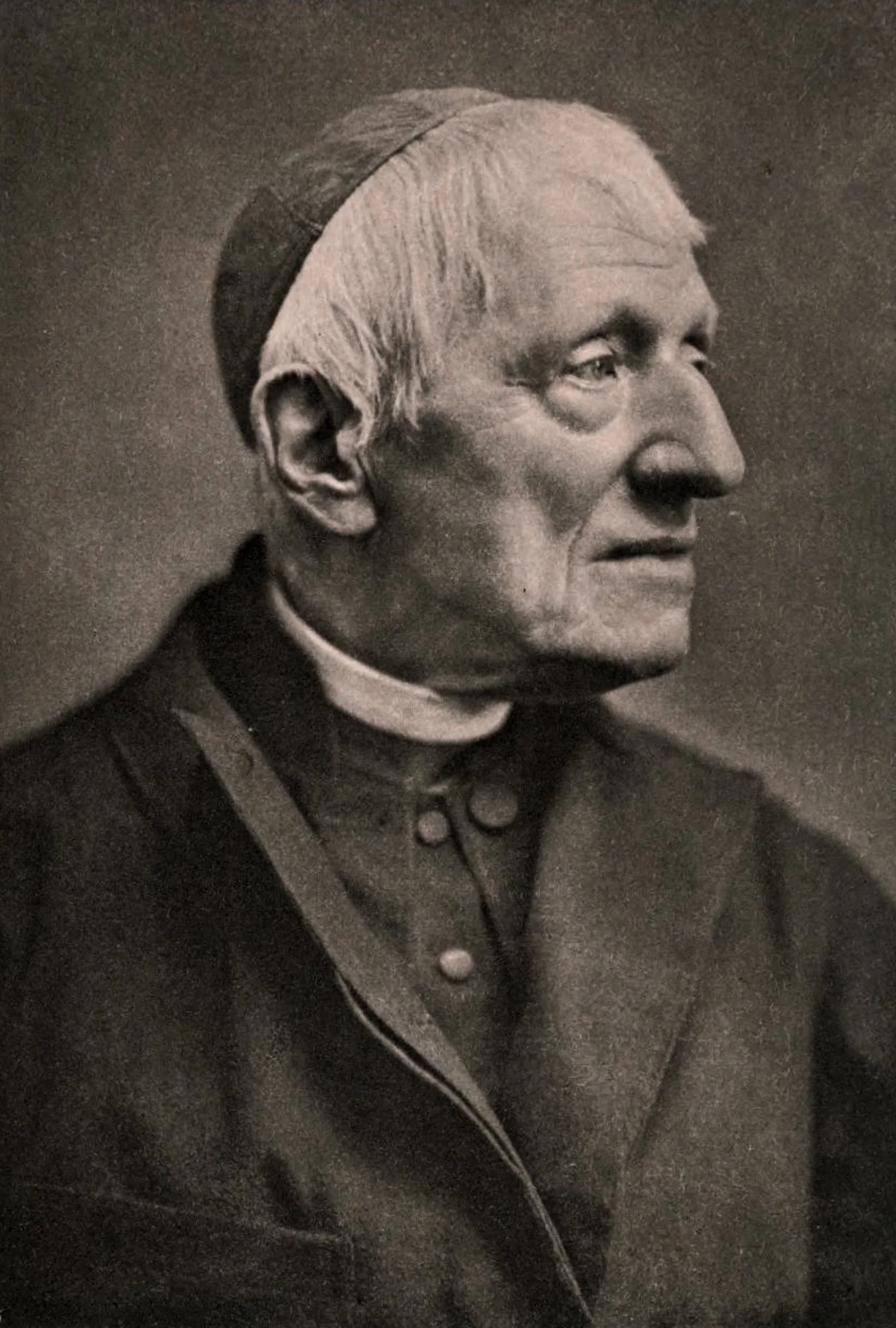
It can be difficult to imagine that a relatively new saint, and the newest Doctor of the Catholic Church as of 2025, could have lived a controversial life. It seems much more fitting that a saint would have lived a life of piety and quiet contemplation, and yet that was not the life this saint was called to live.
John Henry Newman could only live his life by consistently listening to the voice of God and his conscience. No matter what ramifications this commitment carried, he was true to this pledge. He followed what he heard in his head, heart, and soul, even when it brought exclusion and consternation.
When we think of the saints, ideas of perfection, astuteness, and a life of quiet adherence to God’s Will often come to mind. We don’t think of saints as inflexible, uncompromising people who provoked arguments like St. John Henry Newman. Yet, Newman’s adherence to his calling earned him one of the most respected positions in the Catholic Church. He joins only 37 other Catholic men and women from throughout 2,000 years of our Church’s history to share the title Doctor of the Church, including Augustine, Thomas, Teresa, and Catherine.
All the saints, in whichever era they lived, were expected to speak boldly the message the Holy Spirit inspired them to relay to the world. We are likewise spoken to by the Holy Spirit; however, we may not recognize His voice and therefore not be aware of what He is asking of us. We are each invited to develop the ear of our heart to discern the voice of the Holy Spirit and to speak boldly what He is asking us to speak on His behalf. This will carry risks and we are encouraged to count the cost of our actions (Luke 14:28). We may lose friends, challenge work associates, be convicted to change the format of our company, or make family members uncomfortable. Saint John Henry Newman was aware of all these risks, and yet, he continued on the path that he was called to walk throughout his earthly life.
Newman was born in 1801 in London and died in 1890 in Philadelphia. Born into the Anglican faith, Newman was a brilliant student and became an Anglican priest. In 1833, on a trip to Sicily, southwest of Italy in the Mediterranean Sea, he became seriously ill. Upon his recovery, he returned to England and continued to serve as a priest in the Anglican faith. However, while in Italy, he had been introduced to Catholicism and he “became increasingly convinced that the Church of Rome, the Catholic Church, was the church nearest to the spirit of early Christianity.” (https://www.newmancanonisation.com/newmans-life)
In 1845, at the age of 44, Newman met with Father Dominic Barberi, a Passionist priest who was in England on missionary work. Father Barberi heard Newman’s confession, which lasted so long, “Father Dominic insisted that they go to bed and resume it in the morning” (https://www.newmancanonisation.com/newmans-life). When his confession was complete, Father Dominic welcomed Newman into the Catholic Church.
Saint John Newman’s Second Conversion
Newman next went to Rome to study for the Catholic priesthood and he was ordained a Catholic priest in 1847. He returned to England, no longer an Anglican priest, but as a Catholic priest, to serve, inspire, and teach the Catholic faith in this Anglican country. Newman was ostracized and excluded by his former colleagues and countrymen because his Anglican friends believed he had abandoned their faith tradition with his defection to the Church of Rome. During his conversion, Newman wrote An Essay on the Development of Christian Doctrine which was first published in 1845 and revised 1878. This book explains that doctrine – the beliefs and philosophy of Catholic Christianity – is not unchanging, but rather evolves over time, adapting to the challenges and concerns of each new era, while maintaining its core principles. (https://archive.org/details/a599872600newmuoft/page/n13/mode/2up).
He taught: “for an idea to remain truly itself, it must be able to change, to develop,” because ideas are living and should inspire and invigorate the hearts of Christians. (https://www.newmancanonisation.com/newmans-life).
Saint Augustine provided great inspiration for Newman, especially with the statement that “the verdict of the world is conclusive.” Newman understood this to mean the Catholic Church holds the essential truth and the answers he sought. It also meant the undying faith of the saints and martyrs provided the verdict for the world, and their deaths were conclusive: Catholic Christianity is the one, true religion and the way to God (https://www.newmancanonisation.com/newmans-life).
Conversion is never an easy or simple process, whether in a faith tradition, ideology, or a psychological transformation. Conversion requires us to be transformed in our thinking first and our actions second. The word conversion comes from the Latin word converto, which means ‘to turn around.’ In order to turn around, we must stop, have a reason for turning around, and then decide if turning around is something we want to do, which all precedes the action of change or conversion. It may seem so much easier to continue on the path we have assumed, rather than to respond to the call of the Holy Spirit to make a change, as Saint John Henry Newman did. It was through great courage, introspection, and committed action that he followed through on his convictions, thus making the changes that created controversy for him throughout his lifetime.
Newman’s commitment to speak and write according to the guidance of his conscience was rewarded in 1879 by Pope Leo XIII, who himself had undergone a period of controversy regarding his liberal perspective and social justice concerns (https://onepeterfive.com/leo-xiii-first-liberal-pope-who-went-beyond-his-authority/). Newman requested that he be named a cardinal so he could remain in England and continue to study. As an intellectual, he wanted to continue to write and develop spiritual materials for our Catholic faith. If he had been named a bishop, he would have had to take on an administrative role in his diocese, but as a cardinal, he would not only be validated for his ideas, he would have the opportunity to continue to develop them.
Following our conscience is the work of mature adulthood, and while it is not always easy to align our decisions with how our conscience is leading us, it is an expectation for all Catholic Christians to do so. As Dignitatis Humanae explains, “it is through his conscience that man sees and recognizes the demands of the divine law. He is bound to follow this conscience faithfully in all his activity so that he may come to God who is his last end. Therefore he must not be forced to act contrary to his conscience.” (art. 3) Saint John Henry Newman followed his conscience with his conversion to the Catholic Church, bringing consternation upon himself.
When he was only 25 and still Anglican, Newman delivered his Sermon “Holiness Necessary for Future Blessedness.” He taught that the holy life must be our continual aspiration, with heaven as our destination, explaining that if we choose to live an unholy life, heaven will feel so unnatural and unwelcoming, we will only desire to depart from it. However, if we live a holy life, heaven will not only be our reward, but it will be an eternal home that fits us perfectly. He said: “Holiness, or inward separation from the world, is necessary for our admission into heaven, because heaven is not heaven, is not a place of happiness except for the holy.” (https://www.newmanreader.org/works/parochial/volume1/sermon1.html).
According to the Catechism of the Catholic Church, “there is no holiness without renunciation and spiritual battle. Spiritual battle entails the ascesis, (severe self-discipline for religious reasons) and mortification (embarrassment or shame) that gradually lead to living in the peace and joy of the Beatitudes.” (CCC, 2015). If our expectation is that our earthly life will be easy and without struggle, and yet we hope to attain eternal life in heaven, that is simply inconsistent with our Catholic faith. This belief is immortalized in the Cross, as the Catechism explains: “The way of perfection passes by way of the Cross.”
Newman understood this truth and his personal motto – Heart speaks to Heart, borrowed from St. Francis de Sales – fed his soul throughout the struggles he endured for the Catholic faith. It was Christ’s Sacred Heart that spoke to his human heart (https://www.commonwealmagazine.org/heart-speaks-heart). He died from complications of a stroke at the age of 89 on June 5, 1890 in Philadelphia, Pennsylvania on his way to do errands. On his grave, he wished only for the saying, “from shadows and images unto truth,” as a statement about the life he lived (https://www.ncronline.org/news/moving-cardinal-newmans-body-runs-controversy). The poem he wrote in 1834, “Lead, Kindly Light,” expressed his struggles and his hope.
Lead, Kindly Light
Blessed John Henry Newman (1801-1890)
Beatified by Pope Benedict XVI
September 19, 2010
by Blessed John Henry Newman (1834)
Lead, Kindly Light, amid the encircling gloom,
Lead Thou me on;
The night is dark, and I am far from home,
Lead Thou me on.
Keep Thou my feet;
I do not ask to see the distant scene;
one step enough for me.
I was not ever thus, nor prayed that
Thou shouldst lead me on;
I loved to choose and see my path; but now
Lead Thou me on.
I loved the garish day, and, spite of fears, pride ruled my will;
remember not past years.
So long Thy power hath blessed me, sure it still
Will lead me on.
O'er moor and fen, o'er crag and torrent, till
The night is gone;
And with the morn those angel faces smile,
Which I have loved long since, and lost awhile.
Kate Walsh-Soucheray is a wife of 42 years, a mother of three adult, married children, and grandmother of six beautiful, active grandchildren. She is a former Catholic high school Religion teacher and a former Christian Licensed Marriage and Family Therapist. Dr. Walsh-Soucheray writes a monthly column for the Catholic Spirit, the Archdiocesan newspaper of Minneapolis and St. Paul, called Simple Holiness. She is now retired and writes and speaks for Catholic women’s groups, Cana Dinners, and leads retreats for Catholic groups about integrating holiness into our everyday lives. Find her daily reflection and encouragement for Catholic women on LinkedIn.