

Saint Polycarp: An Inspiring Witness in the Apostolic Church
“Always be ready to give an explanation to anyone who asks you for a reason for your hope” (1 Peter 3:15).
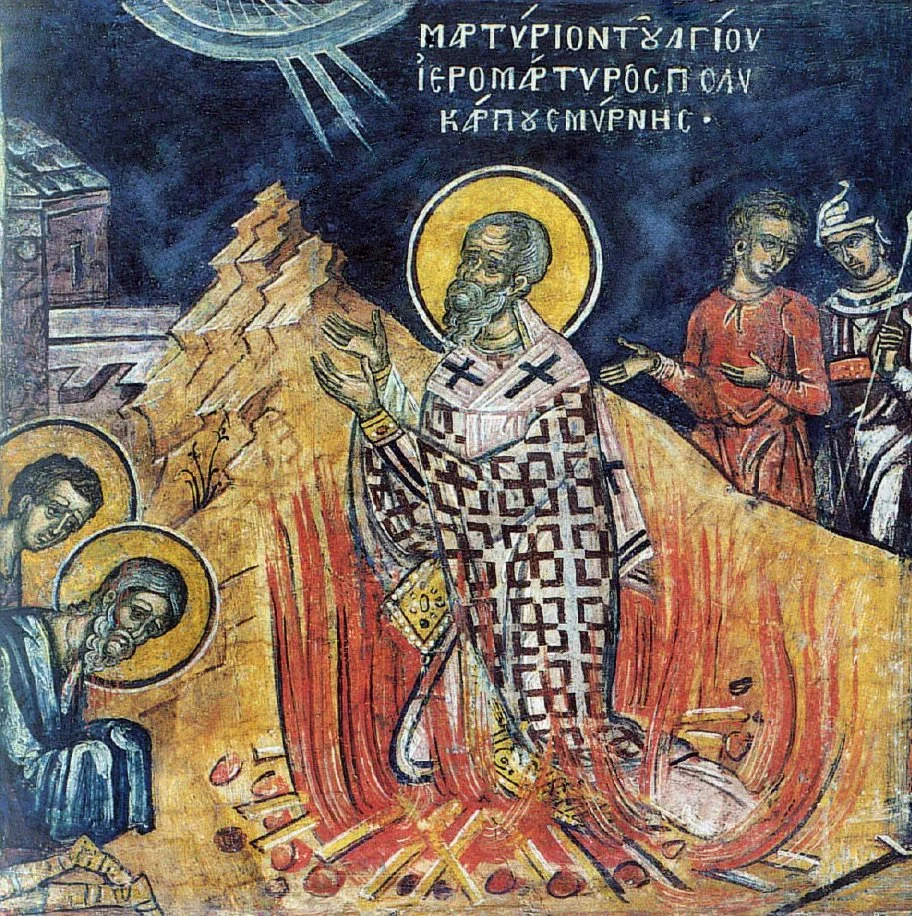
Saint Polycarp was one of the earliest defenders of Christianity. He was a disciple of Saint John the Apostle, and therefore provided a bridge between those who knew Christ directly and those who would learn indirectly about Him and His teachings and make the choice to devote their life to His way.
A Courageous Defender for the Early Christian Church
Saint Polycarp was born in 69 A.D. to Christian parents in Smyrna, Asia Minor, which is current-day Turkey. This is significant because Saint Paul had written all of his letters by this time; however, the Gospels had not yet been written. Those who heard about Jesus of Nazareth – the One who died and was resurrected – chose to believe in Him and His miraculous powers, as well as the Holy Spirit who flowed from Him and God the Father.
This was no insignificant choice for those who lived in the Roman Empire in the mid-first century. The residents of the Roman and Greek cultures worshipped pagan religions, and the only faith tradition with a belief in a single God at the time was the Jewish faith, from which Christianity arose. We often take our Christian faith for granted today. At the time of Saint Polycarp, however, it was through great courage and deep conviction that the earliest followers of Christ helped to spread this fledgling faith tradition throughout the then-known world.
Tertullian, who lived and wrote toward the end of the second century, witnessed the willingness of the early Christians to give their lives for their belief in the Risen Lord. He is quoted as saying: “The blood of the martyrs was the seed of Christianity.” It was the willingness of these early martyrs to stand firmly for what they believed and to risk their death, rather than commit apostasy, or denial of the faith, that inspired others to want to know Jesus. Saint Polycarp certainly provided an inspiring witness – through how he lived and how he died – to the life we have in Jesus.
Saint Polycarp was a critical link between the apostles who followed Jesus and those who would seek to know Him in the subsequent centuries. Even though marked by persecution and death, this second wave of followers defended the Christian faith. Polycarp spoke out about the reality of Jesus’s earthly life, and refuted the false teachings that were circulating that Jesus was only a spiritual entity and never inhabited human form. Polycarp was named bishop of Smyrna, Asia Minor, by Saint John. He then acted as primate of Asia Minor, or chief bishop over all the other bishops. He fulfilled his duties with great zeal, professing the reality of the Resurrection of Our Lord. (This was no small feat because travel was difficult and treacherous in this region of the Roman Empire.)
Saint Polycarp was arrested and burned at the stake in 155 or 156 A.D. His 86 years were spent defending Christianity and the life we have in Christ when we live true to our faith in Our Risen Lord. His outspoken courage and conviction are qualities we can emulate in our own lives as we challenge a culture that does little to encourage holiness or sanctity in any form. Our very lives can provide a living witness to the truth of our faith in Jesus Christ and how He inspires us to profess the truth of who He is. We can and must live so that others ask:
“What is different about her?”
“Why is your company or organization thriving at a time when others are floundering?”
“What do you possess that makes you so alive and radiant?”
Our Christianity must be so evident that it shapes our very lives and all our interactions with others.
Inspiring Us to Live Holy Lives
Through the way you live your life, you have the opportunity to invite others to know Jesus and choose to join in your commitment to the Beatitudes and the virtuous life. We may not be asked to sacrifice our lives through martyrdom; however, we may experience ostracization and exclusion for the sake of Christ. It was for this that Saint Polycarp offered his life, and on his feast day of February 23, we can honor him by saying his prayer:
“O Lord God Almighty, the Father of thy beloved and blessed Son Jesus Christ, by whom we have received the knowledge of Thee, the God of angels and powers, and of every creature, and of the whole race of the righteous who live before thee, I give Thee thanks that Thou hast counted me worthy of this day and this hour that I should have a part in the number of Thy martyrs, in the cup of thy Christ, to the resurrection of eternal life, both of soul and body, through the incorruption [imparted] by the Holy Ghost. Among whom may I be accepted this day before Thee as a fat and acceptable sacrifice, according as Thou, the ever-truthful God, hast fore-ordained, hast revealed beforehand to me, and now hast fulfilled. Wherefore also I praise Thee for all things, I bless Thee, I glorify Thee, along with the everlasting and heavenly Jesus Christ, Thy beloved Son, with whom, to Thee, and the Holy Ghost, be glory both now and to all coming ages. Amen.”
Resources for Further Study
Prayer of St. Polycarp: https://www.orthodoxroad.com/voices-from-the-past/the-martyrdom-of-st-polycarp/
St. Polycarp’s Life: https://www.catholic.org/saints/saint.php?saint_id=99
A Short History of the Catholic Church, Holmes & Bickers, 1983, Burns & Oates.
The Church at Prayer: The Eucharist, Volume II, Cabie, 1986, Liturgical Press.
The New Jerome Biblical Commentary, Brown, Fitzmyer, and Murphy, 1990, Prentice Hall.
Dr. Kate Walsh-Soucheray taught high school religion in St. Paul, Minnesota and then became a licensed marriage and family therapist. She has master’s degrees in theology and marriage and family therapy, and a doctorate in educational leadership. Dr. Kate and her husband John have been married for 42 years and they have three, adult married children and six, soon to be seven, grandchildren. Dr. Kate is retired and writes and speaks for Catholics.