“Magnifica Humanitas:” Takeaways for the Catholic Businesswoman
“The most extraordinary scientific progress, the most astounding technical feats and the most amazing economic growth, unless accompanied by authentic moral and social progress, will in the long run go against man” (Pope St. Paul VI).
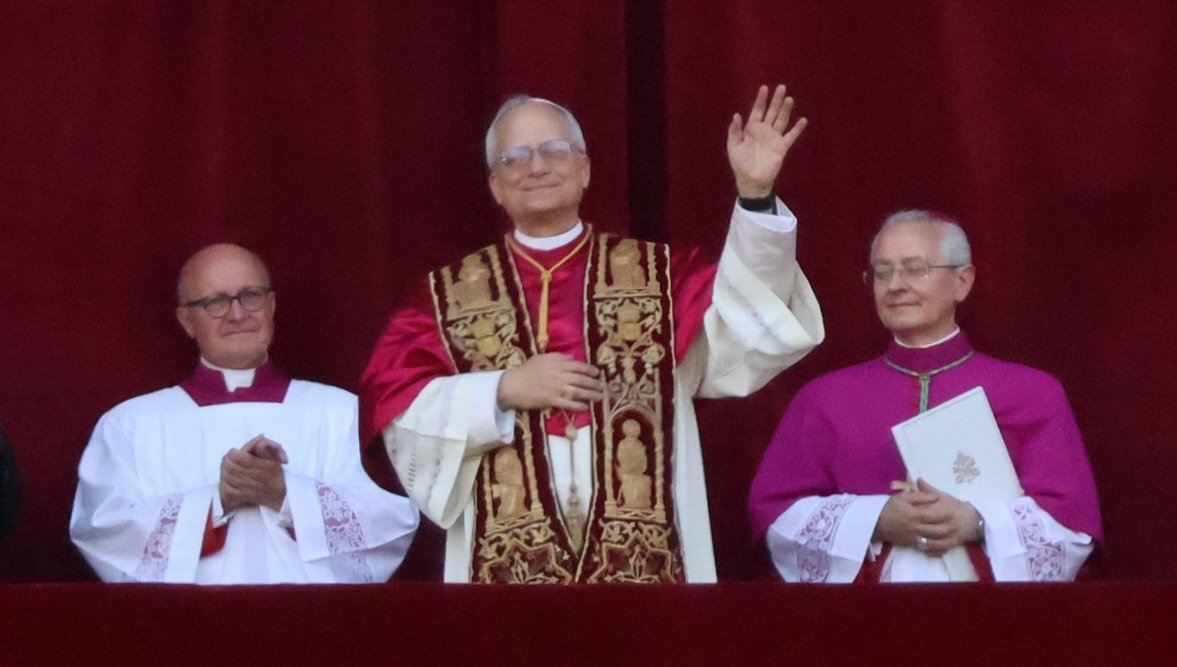
Edgar Beltrán / The Pillar, CC BY-SA 4.0 <https://creativecommons.org/licenses/by-sa/4.0>, via Wikimedia Commons
Just over a year into the papacy of the first American pope, Pope Leo XIV has released his first encyclical: Magnifica Humanitas (“Magnificent Humanity”). Subtitled “Safeguarding the Human Person in the Time of Artificial Intelligence,” the encyclical is timely, beautifully written, and challenging.
There is so much to digest and pray about, and I recommend that everyone read the encyclical in full (like other encyclicals, it’s available for free on the Vatican’s website). In the meantime, however, I’ve gathered five takeaways for Catholic professional women. I’ll be meditating on them over the coming days, weeks, and months. I hope you will, too!
First, Some Definitions
An encyclical is a letter by the pope that addresses religious and moral topics. Magnifica Humanitas in particular is a successor to Rerum Novarum (“Of New Things”), Pope Leo XIII’s landmark encyclical that laid the foundation of Catholic social teaching.
I asked my husband, a computer scientist, if there is a standard definition of artificial intelligence. He laughed. Then he handed me his AI textbook from grad school, which has eight definitions of AI. Fundamentally, though, AI involves developing algorithms (a series of instructions) that can learn and improve from their surroundings (i.e., data). ChatGPT is a well-known example, of course, but by now you’ve also seen AI results in your Google searches — with mixed accuracy.
The benefits of and concerns regarding AI are beyond the scope of this article, though they are largely addressed by Pope Leo XIV in Magnifica Humanitas. Regardless of whether we are on board with the technology, it’s here. And I firmly believe — especially after reading Magnifica Humanitas — that Catholics need to be involved.
The Construction of Babel or the Rebuilding of Jerusalem
Pope Leo presents two images from Scripture: the construction of the tower of Babel — which stemmed from pride and resulted in chaos — and the rebuilding of the walls of Jerusalem which happened in humility and in submission to God.
Ultimately, the key question remains the one posed by Saint John Paul II: does AI “make human life on earth ‘more human’ in every aspect of that life? Does it make it more worthy of man?” If the answer is yes, then we can recognize it as an opportunity to be embraced responsibly, on a path of patient, shared reconstruction, akin to the rebuilding of Jerusalem narrated in the Book of Nehemiah. If, however, power grows while the heart withers and human bonds fray, then we are faced with a new form of Babel — a construction that is grandiose, yet fundamentally dehumanizing (129).
His call to action: “The construction of Babel or the rebuilding of Jerusalem begins within each one of us” (130).
The Vocation to Business
Our mission statement at Catholic Women in Business states that we “provide Catholic women business owners, professionals, and leaders with the educational and spiritual resources they need to excel in their vocation to business.” Pope Leo XIV says that “entrepreneurial initiative can indeed be a true vocation, generating wealth and improving lives, rather than a variable that is dependent only on profit” (157).
AI can support this vocation, but it can’t supplant it. The Holy Father cautions leaders of AI companies and initiatives to protect employment, ensure training and development of workers, and “include quality and dignity of work among its indicators of success” (156).
Humanity Over Efficiency
Perhaps my favorite part of Pope Leo’s encyclical is his argument that we cannot allow a focus on efficiency and optimization to overlook the redemptive nature of suffering or to cast off the disabled and disadvantaged as useless. People aren’t human resources or human capital. We’re human beings, made in the image and likeness of God. Our value “does not depend on what [we] achieve or produce” (52), and “No sin, failure, humiliation or exclusion can diminish the profound value of a human life that God has willed and called into being” (61).
The Holy Father says that it is right that we alleviate suffering when we can. Still, “it is precisely within our limitations that the following find a place: compassion, as well as a sincere concern for the needs of others; a generosity that can emerge even in the midst of darkness and failure; spiritual experience and the worship of God” (119). Humans are designed to want more — to want transcendence, to want Love Himself — but transhuman philosophies say that our salvation is in technology, not in God. “For an algorithm, an error is a flaw to be corrected; for a person, however, an error can be a catalyst for profound change. A person’s future is not calculable, but depends on one’s freedom — elevated by the inexhaustible grace of God — and on the relationships cultivated” (128).
“Christian humanism,” on the other hand, “does not reject science or technology, but embraces them with gratitude and realism, and grounds them within a higher vocation” (129).
The Role of Women
Pope Leo says that it is not enough “to state simply that men and women have equal dignity and rights; it is necessary that this be reflected in concrete decisions, such as in laws, access to employment, education, social and political responsibilities, and the way society listens to and values women’s contributions” (57).
He doesn’t explicitly state what those contributions are, but saints such as Pope St. John Paul II and St. Teresa Benedicta of the Cross (Edith Stein) wrote extensively about what John Paul II called the feminine genius. A later statement in Magnifica Humanitas calls some of their work to mind:
The pervasive technocratic paradigm in which we are immersed, and that is amplified by the digital revolution and AI, threatens to normalize an anti-human vision. In that vision, the fullness of life is equated with having more, reducing weakness, eliminating uncertainty and exerting total control. When efficiency becomes the ultimate measure of value, human beings are tempted to see themselves as a project to be optimized rather than as persons called to relationship and communion (112).
Another pope and saint, Paul VI, might say that combatting this vision is a task especially suited to women. As he wrote to women in the closing of the Second Vatican Ecumenical Council:
You women have always had as your lot the protection of the home, the love of beginnings and an understanding of cradles. You are present in the mystery of a life beginning. You offer consolation in the departure of death. Our technology runs the risk of becoming inhuman. Reconcile men with life and above all, we beseech you, watch carefully over the future of our race. Hold back the hand of man who, in a moment of folly, might attempt to destroy human civilization.
Perhaps even more to the point, Pope Leo writes:
Reading stories to a child, offering company to an elderly person and arranging a home so that it is welcoming are simple gestures often rooted in family life. They teach us to value care at a societal level and train us to recognize others as persons worthy of attention. Technology can also support this mutual care between people, for example, by providing tools that help us anticipate and organize things, without undermining human freedom and judgment (114).
How many of these activities are performed by women! (And what fresh light it shines on my daily activities in my home and with my bookworm children!)
A Program of Christian Life
Toward the end of the encyclical, Pope Leo outlines “five paths toward daily and public responsibility” for peace (213) and “a sober yet demanding program of Christian life” (229) — a way of living in a world of AI.
The five paths toward peace are:
Examining the language we use and making sure that it promotes truth, justice, and charity.
Cultivating “the true peace born of justice” (215).
Empathizing with the victims of violence and raising up their voices.
Finding the middle way between a naive idealism and nihilism — an “authentic realism” (218).
Building fraternity through dialogue — not just between nations but between individual people.
The program of Christian life involves:
An approach like the one Mary takes in her Magnificat — one that contemplates God’s plan and mercy.
Living a Eucharistic life and Eucharistic spirituality, remembering that “at the heart of everything is the mystery of the Incarnation” (231).
Centering our culture on the common good and “cooperat[ing] in the work of creation rather than be[ing] disinterested observers of technological processes that limit our freedom and responsibility” (233).
Praying with the Blessed Virgin Mary.
There Is Hope
In his passages on war especially, Pope Leo paints a seemingly bleak picture of our present and future. However, he reminds us that there is hope. “We view history in the light of the crucified and risen Lord, to whom the Father has given ‘all authority in heaven and on earth’ (Mt. 28:18),” he reminds us.
Consider your favorite saints. “Even in the darkest nights, the Lord raises up men and women who refuse to give up, who persevere in doing good, who protect the vulnerable and open pathways to reconciliation. The memory of the saints, righteous people and the oft-forgotten peacemakers, show us that grace does not magically eliminate conflict, but instead it inspires active resistance to evil and an astonishing creativity in doing good” (211).
Finally, the Holy Father combines hope with a call to action:
We all have our own areas for action, and it is precisely there — and nowhere else — that we must choose whether to fuel the mentality of force (even if only through indifference, cynicism, lies or hatred), or to preserve the mindset of peace (with truth, moderation, closeness and care) … The civilization of love will not arise from a single or spectacular gesture, but from the sum total of small and steadfast acts of fidelity that serve as a bulwark against dehumanization” (212-213).
It’s already been all over the internet that Pope Leo quotes The Lord of the Rings here. It’s one of my favorite novels; but his remarks also remind me of the closing line in Middlemarch, by 19th-century British female novelist George Eliot: “That things are not so ill with you and me as they might have been, is half owing to the number who lived faithfully a hidden life, and rest in unvisited tombs.”
How many unknown saints are there in Heaven who simply did their duties of the moment, “small and steadfast acts of fidelity that serve as a bulwark against dehumanization”? And how many of us will play our small role in the AI revolution to ensure that we never lose sight of the dignity — and magnificence — of the human person?
Mary is not an unknown saint. But she lived an ordinary life in an extraordinary way, with an extraordinary Son (and with extraordinary grace). Pope Leo ends his encyclical by referencing the Blessed Mother and asking us to, like her, “become ‘weavers of hope’ in our world, sharing who we are and what we have, so that the presence of Jesus may grow among us and his Kingdom take shape” (245) — even with artificial intelligence.
Taryn DeLong, co-president of Catholic Women in Business, co-wrote Holy Ambition: Thriving as a Catholic Woman at Work and at Home (Ave Maria Press) to help women hear and follow God’s unique calling for their life. Following her own calling, she currently spends much of her time caring for and homeschooling her two daughters.
Taryn studied psychology and education at Meredith College in Raleigh, NC. Before becoming a mother, she worked in university advancement and then B2B editing.
Since Taryn was a child, she’s called the Raleigh area home, and she and her husband are now raising their family in a small Raleigh suburb. In addition to supporting Catholic women, she's passionate about inclusion of people with disabilities in life, work, and (most importantly) the Church. She also enjoys reading and playing the piano.
Connect with Taryn on Instagram, Facebook (and her Facebook group for Catholic working homeschool moms), LinkedIn, her blog, and Substack.