

Book Review: Pocket Guide to the Mass
It was through the Catholic Mass that I first found my way into the Catholic faith. Five years ago, my teenage son announced that he had decided to become Catholic. Though surprised, I was not in any way opposed to his decision. Curious about his choice, I began attending Mass with him, and over time, something in me was awakened. Whatever I was encountering in the Mass, I found myself wanting more of it. In 2024, after completing the Order of Christian Initiation of Adults (OCIA), I, too, joined the Catholic Church.
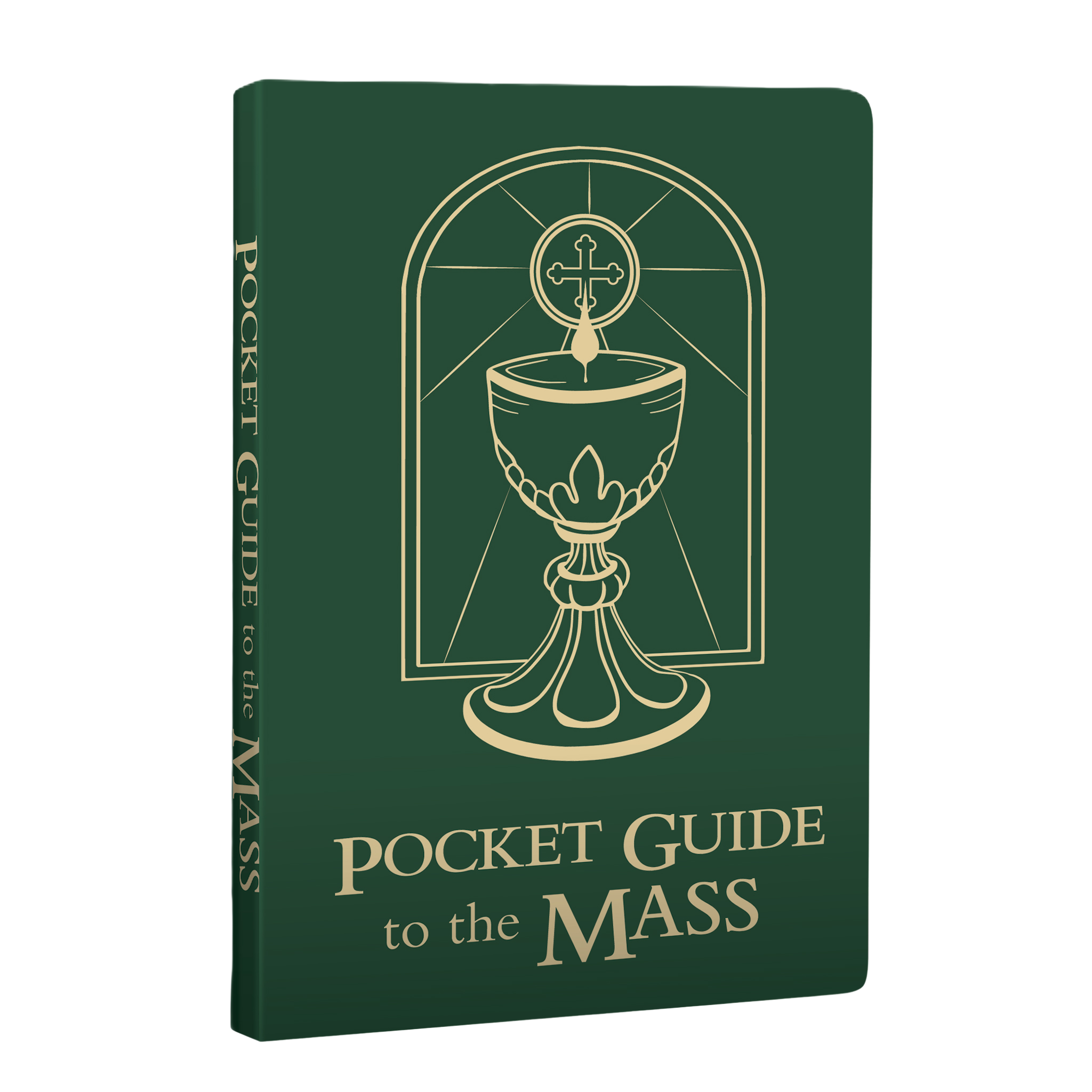
Ascension recently published a new guide to the Mass titled “Pocket Guide to the Mass” by Father Mike Schmitz and Dr. Edward Sri. As the title suggests, it is brief and small enough in size to fit in your pocket and carry with you to Mass. The first sentence in the guide asks, “Do we really understand what is happening in every Mass?” That very question motivated my own journey. I knew something very special was happening when I participated in Mass. I knew this in my heart long before my mind engaged with the question. Eventually, my mind did want to know what my heart was experiencing. OCIA covered the basics, of course, but a deep understanding of the Mass, like many aspects of the Catholic faith, benefits from review and reflection.
So, I was very happy when Ascension released this book. Composed of four sections, “Pocket Guide to the Mass” starts with an invitation to “go deeper” by Dr. Sri. He encourages the reader to imagine seeing the Mass through the eyes of the angels and to recognize that it is “the most amazing event taking place in the universe!” Section One explains the history of the Mass and each of its parts. This is followed by Section Two: “The Order of the Mass,” which can be a useful resource to follow along with during the Mass. Section Three is “The Teaching Mass” by Father Mike Schmitz. Finally, Section Four concludes with prayers to be said before and during Mass.
Foundations and History of the Mass
I love thinking about how old the Mass is and how many generations have come before me on their knees to receive the Eucharist. Much of what we experience in Mass today, including some of the prayers, can be traced back to the early Church. According to the guide, “If you could get into a time machine and attend a Mass in Rome during the early centuries of the Church, you would recognize many familiar elements in how the Liturgy is arranged, the various rites, and even some of the prayers.”
There are four main parts to the Mass: the Introductory Rites, the Liturgy of the Word, the Liturgy of the Eucharist, and the Concluding Rites. The Communion Rite is the high point of the Liturgy of the Eucharist and is the “most intimate union we can have with God here on Earth.” Before encountering this sacred union with God, we properly
prepare ourselves by reciting the Our Father, the Rite of Peace, and the Lamb of God.
Afterwards, we experience the same closeness with Jesus as Mary did when she carried Him in her womb. We are called to be as lovingly attentive to Him as she was.
The Mass transcends time and space, making present for us “the most perfect act of worship.” We are drawn into the mystery of Calvary, standing spiritually alongside Mary and the beloved disciple as witnesses to Christ’s perfect offering of Himself to the Father. This is not merely a symbolic reenactment of His sacrifice, but its true re-presentation, for the Eucharist contains the Real Presence of Jesus Christ. “Through the Mass, we gradually take on the courage, peace, generosity, and humility of Christ Himself, until we can say with St. Paul, “It is no longer I who live, but Christ who lives in me” (Galatians 2:20).
The Sunday Obligation
Sunday is a day of rest and a day of worship. Catholics are called to participate in Mass every Sunday and on holy days of obligation, but not as some form of chastening or tax on our time. Rather, “the Sunday Mass is meant to be the high point of each week, the summit toward which we unite all our prayers, works, joys, and sufferings with the primary source of grace to shape the week ahead.” I would no more consider missing weekly Mass than I would consider skipping my weekly fill-up at the gas station. Without Sunday Mass, I would find it spiritually difficult to get through the week.
Perfection at Mass is not expected. We are human, and human minds wander. But “we can still offer God our good intention.” One tip the guide offers for remaining focused is to follow along with “The Order of Mass” printed in the guide. In my experience, I have found it to be an easy way to deepen my involvement and get back on track when my mind wanders.
Following the Examples of the Saints
The guide recommends that we imitate the saints in their profound reverence and devotion at Mass. Four examples are provided: Pope St. John Paul II, St. Anthony of the Desert, St. Thérèse of Lisieux, and St. Teresa of Calcutta. My favorite was the example set by St. Thérèse of Lisieux. She focused on making her soul as receptive as possible to uniting with Christ by asking the Blessed Virgin Mary and the angels and saints to clear her soul of impediments, adorn it with finery, and fill it with music. This is the prayer I, too, now will carry in my heart as I approach Holy Communion.
If you are, like me, new to the Mass, or would simply like to understand it better, I recommend Ascension’s “Pocket Guide to the Mass.” I have had mine only a few weeks, and already it is full of notes and dog-eared pages. My mind has now caught up with my heart in fully participating in this “most amazing event taking place in the universe.”
Susan has a bachelor’s degree from Vanderbilt University in Modern European Studies and a master’s degree from Columbia University's School of International Affairs with a concentration in international banking and finance. Her professional start in life began in New York City in corporate lending and relationship management. In 2015, she returned to the classroom to explore her passion for writing, focusing primarily on memoir writing and poetry. Five years later, in 2020, she graduated from Western Connecticut State University with a bachelor's degree in professional writing and began her career as a freelance writer. Susan was born in Florida and raised in Pensacola. She joined the Catholic Church in April 2024.