

The Untold Story of Expat Women Artists in Paris: How Their Ambition Helped Professionalize Art for American Women
“Those who perceive in themselves this kind of divine spark which is the artistic vocation — as poet, writer, sculptor, architect, musician, actor and so on — feel at the same time the obligation not to waste this talent but to develop it, in order to put it at the service of their neighbour and of humanity as a whole” (Pope St. John Paul II).
As Catholics, we believe that beauty matters. As Pope St. John Paul II wrote in his “Letter to Artists,” “The link between good and beautiful stirs fruitful reflection. In a certain sense, beauty is the visible form of the good, just as the good is the metaphysical condition of beauty.” It’s why we have Notre Dame Cathedral in Paris, Bach’s Mass settings, and Michelangelo’s Piet̀a. Beauty helps lift us up to God.
Unfortunately, if you’re American like me, you live in a country that has not always valued beauty, especially through the arts. Until the 20th century, it was difficult for anybody, let alone a woman, to make a living as an artist. A new book by art historian Jennifer Dasal describes an important part of what shifted that reality. “The Club: Where American Artists Found Refuge in Belle Époque Paris” shares the history of the American Girls’ Club and the women who lived and studied there from 1893 to 1914.
An “Embassy of American Women’s Creativity on Foreign Soil”
Dasal describes the American Girls’ Club in this way in her prologue, and based on the remainder of her book, it’s an apt description. In the second half of the 19th century, due to a dearth of opportunities in the U.S. to study art and turn it into a profession, Americans began flocking to Paris. American women did so beginning in the 1870s-80s, often to the chagrin of their parents, who worried about their moral formation and safety so far from home.
Philanthropist and diplomat’s wife Elisabeth Mills Reid, along with Presbyterian minister’s wife Helen Pert Newell, created the Club to provide a safe and affordable place for American female visual art and music students to live. More than a dorm, though, the Club became a place for community and even, eventually, a place for high-quality art exhibitions.
“Angels of the House”
In 19th-century America, the main way women practiced art in a socially acceptable way was as teachers, either of their own children or of others’. Watercolors, embroidery, quilting, and other arts were encouraged as hobbies but not as professions. Still, and interestingly, as Dasal writes:
As arbiters of all things moral and good, women were tasked with lifting their families — and society in general — into a more dignified, beautiful plane of citizenship. The arts proved a vehicle for this endeavor, one that became increasingly necessary in the minds of many as the modern world imperiled the principles of the naive and innocent. Art was a beacon of hope, the inspiration of virtue. … Beauty should be taught, then, to beautify the mind.
As a homeschool mother myself, I found this passage incredibly inspiring! One of my main goals in educating my girls is to cultivate a sense of awe and wonder at the world God created, including a deep appreciation for natural and man-made (and Spirit-inspired) beauty. Women in the workforce, too, often find that they naturally bring more beauty into their workplace, either directly through their job or indirectly through the way they work and behave.
Turning Art Into a Profession
Still, beauty for beauty’s sake doesn’t always bring home the bacon. Many women found that they weren’t taken seriously as artists if they were “just” mothers or teachers (a challenge many mothers and teachers still face today!). In Paris, women found more access to art training and more opportunities to exhibit their work — and earn money for it.
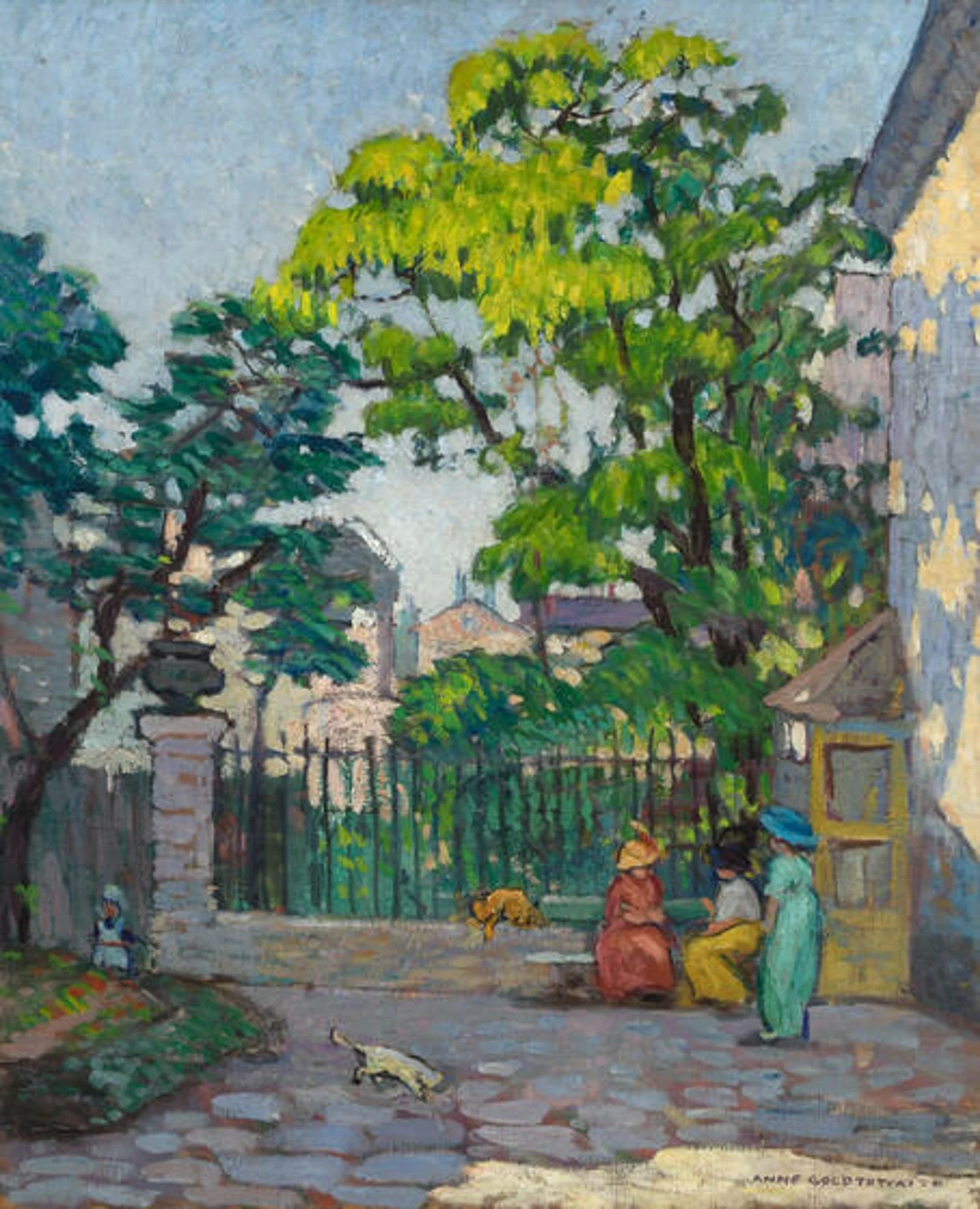
Anna Goldthwaite, for instance, whose painting of the American Girls’ Club building graces the cover of “The Club,” returned to the United States and built a successful career as a teacher and working artist. “Teaching provided the artist with a consistent income,” Dasal writes, but she also received portrait and mural commissions and worked each year at the Dixie Art Colony in Alabama. Eventually, curator Holger Cahill described Goldthwaite not only as “one of the two or three leading women painters in this country” (emphasis mine) but also “the leading painter of the South.”
But Goldthwaite arguably got her start at the American Girls’ Club, where her friendships led to “accidental brushes with people, places, and art that would propel [her] into [her] career’s next stage.” Just a few days after joining the Club, she met Frances Thomason, a fellow Southerner who introduced her to an influential group of artists and collectors that eventually led to Goldthwaite’s experimentations with modern art.
Blending Motherhood and Work
Dasal notes that most of the Club artists who got married “gave up their artistic careers after marriage, particularly if they went on to raise a child or several.” It’s hard to know whether they did so by choice, given the context they lived and worked in (and the fact that juggling work and motherhood is challenging even today).
However, Dasal does highlight a woman who wasn’t associated with the Club but is inspiring in her embrace of her art career and her vocation to motherhood. At age 40, Austa Densmore Sturdevant moved to Paris with her daughters to study art for eight years. Upon her return to the U.S., she bought the Cragsmoor Inn, which became part of an artist’s colony — so she was an entrepreneur as well as an artist and mother.
Dasal also mentions women who never had children of their own but who nevertheless showed great respect for motherhood. Mary Cassatt, who was already an established Impressionist artist when the Club was founded, is famous for her intimate portraits of mothers and their young children in domestic scenes. Club members Cornelia Field Maury, Grace Turnbull, and Susan Watkins were honored for their portraits of mothers and children (Maury and Turnbull) and a little girl on her First Communion (Watkins). My guess is, like Cassatt’s, this work was dismissed by others, especially Americans, as being unimportant due to its feminine subject matter. After all, as Dasal writes, “the majority of acclaimed artwork in mid-twentieth-century America reflected a predilection for hyper-masculine abstraction.”
“After all, give me France,” Cassatt wrote in 1874. “Women do not have to fight for recognition here if they do serious work.”
Taryn DeLong is co-president and editor-in-chief of Catholic Women in Business. Her first book, Holy Ambition: Thriving as a Catholic Woman at Work and at Home, written with her co-president Elise Crawford Gallagher, is out now from Ave Maria Press. She lives with her husband and daughters outside Raleigh, North Carolina.
Connect with Taryn on Instagram, Facebook, LinkedIn, or Substack. Or, visit her website, Everyday Roses.