

Simplify Your Prayer Life
“For me, prayer is a burst from my heart, it is a simple glance thrown toward heaven, a cry of thanksgiving and love in times of trial as well as in times of joy” (St. Thérèse of Lisieux).
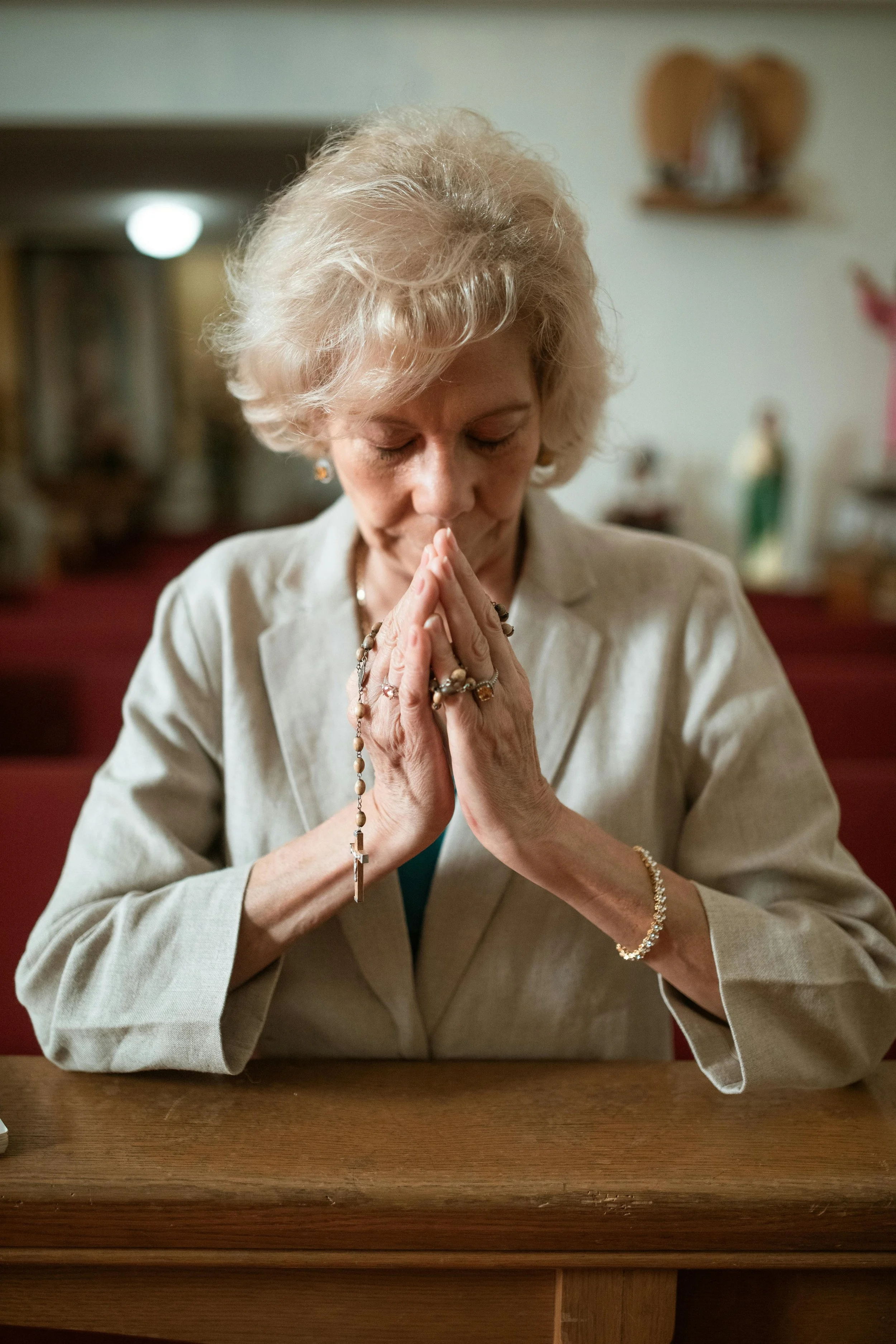
When was the last time you had a one-on-one with God? Were you at church? In bed trying to fall asleep? Were you in crisis or simply wanting to offer up your gratitude?
The way we pray varies widely, and it changes as we change. We may choose to:
Communally recite the creeds that proclaim our belief system.
Have a personal conversation with God, in our mind or aloud.
Pray a Rosary, which allows time to meditate on the life of Jesus through the Mysteries.
Practice imaginative prayer.
Recite the Divine Mercy chaplet.
Put on a praise and worship song.
Not a Great Pray-er
A few years ago, I finally admitted I was a terrible pray-er. For years I only dipped my toe into the prayer pool because I felt like prayers were nice words but didn’t necessarily make me feel any closer to God. I felt closest to Him during Mass, especially during reception of the Eucharist when His true presence, under the species of bread and wine, was placed on my tongue and consumed. This wasn’t just an act for the heart or mind. It was also a physical act. Taking communion engages the senses. But was that praying?
Instead of trying to better understand and experiment with my personal prayer style, I did what others recommended and prayed a Rosary or a Novena. I tried just having a conversation with God, but I wasn’t exactly sure what to talk about and I would get tripped up on selecting the right words. I felt like something must be wrong with me because I did what people around me were doing, and yet, I wasn’t satisfied. (This is a recurring theme in my life, as my approach to choosing my profession, running my business, raising children, and in general, how I cultivate a deeper relationship with others is not typical.) However, as many wise people have noted, in the spiritual life, if you aren’t growing, you are dying. My check-the-box approach wasn’t moving me forward. I was spiritually dying.
How We Pray
Praying is simple.
Notice that I didn’t say it is easy. But we can complicate it when we’re told we should cover “these” topics or be in “this” disposition. The point of praying is to spend time together building a relationship. It shouldn’t be complicated.
Prayer allows us to be known.
Prayer is letting God gaze at us. In his book The Naked Now: Learning to See as the Mystics See, Father Richard Rohr describes it like this: “The essential religious experience is that you are being known through more than knowing anything in particular yourself.” Give God access by unlocking the defenses around your heart so you can be “known through”—in a transcendental way, not simply a static or one-dimensional way.
Prayer is dynamic.
The ways we pray change as we change—as we age, gain experience, accumulate more love, more loss, more insight. The way we prayed as children probably won’t fulfill us as an adult. As St. Paul said: “When I was a child, I used to speak like a child, think like a child, reason like a child; when I became a man, I put aside childish things” (1 Corinthians 13:11). Have you invested time finding a way to pray that fits who you are today?
Prayer is creative.
Prayer is a uniquely human experience. When we put rules around how best to pray, we stifle the creativity God gave each of us. We all have a style and that style extends to how we approach what we do as a profession, how we parent, and the ways we go about problem-solving. It extends to the ways to pray, too.
The Rules Are ... There Are No Rules
For so long, when I shut my eyes and tried to feel a connection with the Lord, it seemed as though a steel door stood between us, both of us pressing our palms against the metal trying to make contact with the other. Was there some way to remove this barrier? Or was this just part of the human condition that I’d have to settle for? Should I be content to recite or to verbally download to God and consider it success?
There was only one problem: This way of praying left me feeling lonely for God – deeply lonely – and He was the only one who could untie the tangled-up knots inside me. My knots included failed motherhood moments, dissatisfaction in relationships, self-sabotage, and lots of anger that I couldn’t diffuse. No one but Jesus could fix the broken in me.
There is no “best” way to pray. Imagine being told how best to tell someone you love them. It would put constraints on your individual expression, as if you gave the same Hallmark card every time you told a family member, “I love you.” If we don’t put rules around how to express our love to someone, why would we put rules around how we tell God we love Him?
The key is to identify the prayer practice that most allows us to be honest and vulnerable with God about what’s in our hearts. Having no rules doesn’t mean guidelines aren’t helpful to get you started. Without suggestions, all this freedom to pray in our own way could result in prayer paralysis. As the Catechism of the Catholic Church teaches: “Only when we humbly acknowledge that ‘we do not know how to pray as we ought,’ are we ready to receive freely the gift of prayer. ‘Man is a beggar before God’” (CCC 2559).
A Few More Thoughts on Prayer
I’ll offer some general insights about prayer that may inspire you to step outside of the box during your time with God.
Prayer is dimensional.
It can be mental, verbal, imaginative, or even physical. Praying using my body (hiking, running, walking) helped me open up new spiritual spaces, which I would have never discovered had I not given myself the freedom to be creative.
Prayer isn’t about feelings.
In my memory, I hear the voices of my theology professors at Franciscan stressing that how we feel isn’t the litmus test for something’s effectiveness. This idea often came up in discussions around the different energy we have in Catholic Mass versus a Protestant service. The professors would comment that the measure of something’s effectiveness isn’t determined by the feeling it elicits. Worshipping God isn’t about us; it’s about Him. He may choose to console us, but that's a pure gift, not what we should expect each time.
Prayer helps us learn to die to self.
When we pray, we place ourselves on the altar for God, making a sacrifice of ourselves to Him and for Him. It can wring us out, but it can also free us. Prayer allows God to show us how to swap out our selfish tendencies and open ourselves to loving in a new way. Dying to yourself involves letting go of your own ideas of right and wrong, letting go of the outcome, letting go of your will. God knows how painful it is for us, but if we let Him, He will scoop us up, tend to our wounds, wipe our tears, and remind us of all the ways He delights in us.
My false starts with prayer were more about me than about God. I wasn’t invested in solving the existential puzzle but, instead, let myself get distracted with work, raising small kids, and trying to achieve and earn my worth. But my loneliness for God (which He put inside me) only grew.
And Then the Scales Began to Fall
My breakthrough with prayer happened during a series of events where I had no control of the outcome. High-achievers and power-house leaders do an impressive job believing the outcome depends on our “can-do” attitude. It can take people with these traits (me!) a long time to reach the end of themselves. But don’t be fooled: It will eventually come.
Realizing how little control I had, I was forced to face things about myself that I didn’t want to see. Weak and broken at the crossroads, I found God waiting for me, and the scales began to fall from my eyes.
He told me I didn’t have to strive anymore; I had nothing to prove. His love for me wasn’t something I needed to earn. His love, He said, was a gift, and if I never did another thing for the rest of my life, it wouldn’t change how much He loves me. He doesn’t love me because of what I could do; He loves me because of who I am.
My prayer time changed after this experience. I don’t have to recite words as though they are a combination code that opens a safe. The safe is unlocked, and He is inside, waiting for me. Don’t get me wrong; I still fall into cycles where I need to be reminded that He loves me and there’s nothing I can do about it (thank you, Fr. Shawn Monahan, for this tagline), but prayer now looks more like falling into His arms, seeking His solace, His peace, needing to hear one more time that I’m enough as I am.
Now, simply breathing is prayer to me.
Your Turn
Are you open to discovering a way to pray that is utterly unique to you? Get a read on where you are spiritually: Are you content? Seeking deeper connection? Too busy to think about it? Not sure?
Ask yourself:
Am I satisfied with my prayer life?
Am I open to trying something new?
What is the state of my interior life? Do I spend time thinking my thoughts and feeling my feels? Do I process in the quiet times?
Let your answers be a conversation starter with God.
Here’s one last tip: It helps me to take long hikes in the woods, without my phone (or putting it on Do Not Disturb), and just ask God questions out loud. Who cares if the squirrels look at me funny? One thing I’ve come to trust is that when we invite Him into our space, He shows up 100% of the time. You may or may not feel it, but prayer isn’t a feeling. Prayer is trusting. Do you trust Him? Sit with Romans 8:26 and see what happens:
In the same way, the Spirit too comes to the aid of our weakness; for we do not know how to pray as we ought, but the Spirit itself intercedes with inexpressible groanings.
Natalie Hanemann is the founder of Be/Wilder Writer, LLC, a company exploring the intersection of creativity, wilderness, and spirituality. Since 2000, Natalie has worked in book publishing as an acquisitions editor, developmental editor, and ghostwriter. In 2024, Natalie expanded her business to include her love of the outdoors through retreats and meditative adventures. Learn more at www.youbewilder.com.