

St. Teresa of Avila
Mystic, Doctor of the Church, Beautiful Example of Holiness for Women of Today
“His secrets are hidden deep; but all that He does will be best for us, without the slightest doubt,” (St. Teresa of Avila, The Interior Castle, p. 48).
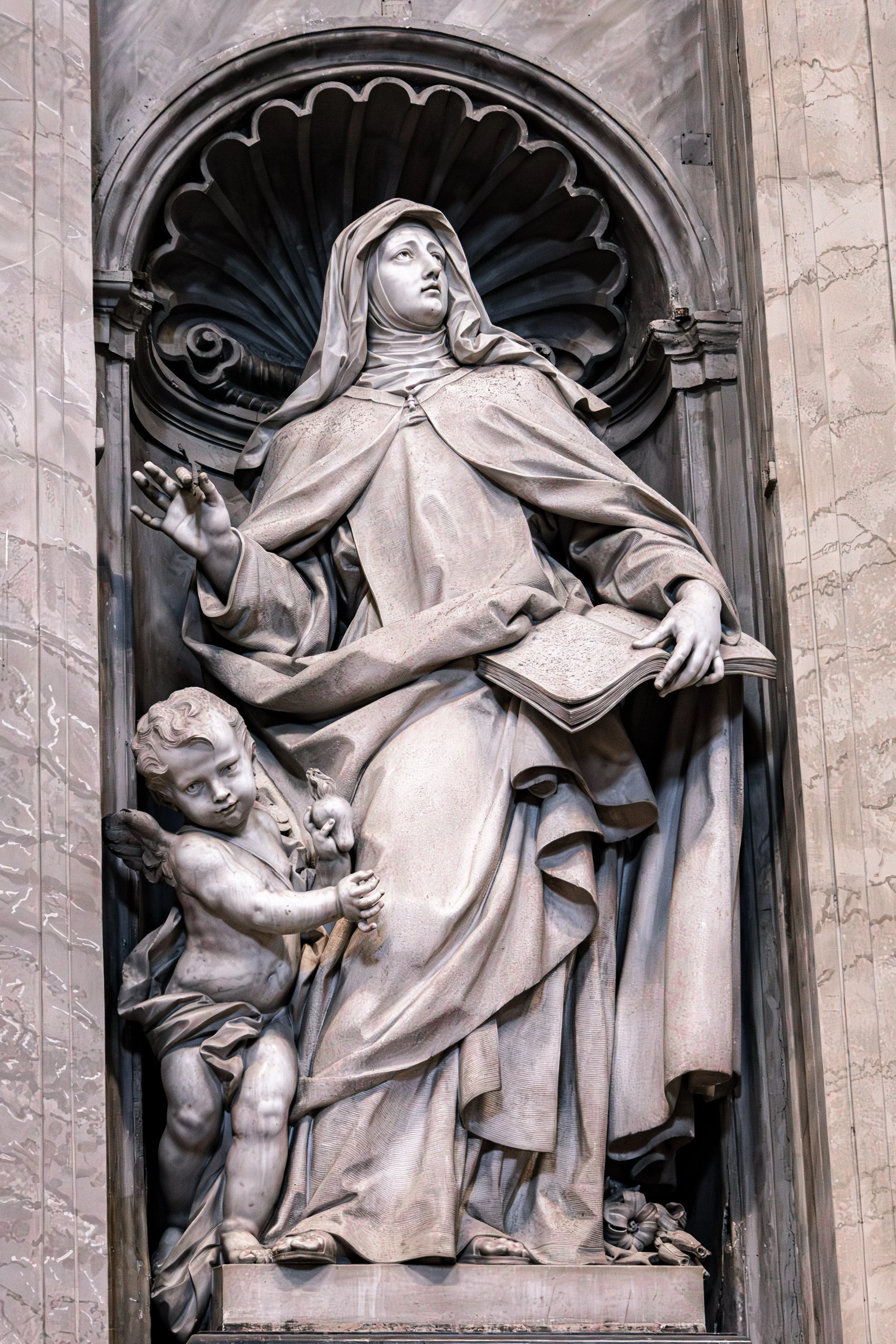
“Teresa of Jesus”
You probably know this, but there are actually four famous St. Teresas (or Thérèse), and I think people get them confused. Two of them are Doctors of the Church: St. Teresa of Avila and St. Thérèse of the Little Flower. Being named a Doctor of the Church is an uncommon designation. There are only 34 male Doctors of the Church and four female Doctors of the Church. The other two notable St. Teresas are St. Teresa of Calcutta (Mother Teresa) and St. Teresa Benedicta of the Cross (Edith Stein). I would like to introduce you to St. Teresa of Avila, Spain, also known as “Teresa of Jesus.”
St.Teresa of Avila was a Carmelite sister who lived in the 16th century. Born in 1515 in Avila, Spain, she was one of 10 children of a wealthy wool and textile merchant and his second wife. Her mother, who loved romance novels and was a devout Catholic, died when Teresa was young. Sources vary as to Teresa’s age, with some contending she was as young as 11 and others as old as 15. At whatever age this occurred, Teresa was grief-stricken at the death of her mother and developed a deep devotion to the Virgin Mary as her spiritual mother.
This left Teresa’s father with a dilemma. Due to the death of his second wife and the marriage of his oldest daughter, he was prompted to send Teresa to be educated at a local monastery. She had an adventurous spirit and was not sure she would enter the convent. However, at age 20, she decided to become a Carmelite Sister at the monastery in Avila. Soon after taking her final vows, St. Teresa was stricken by a serious illness that left her paralyzed for three years. The exact nature of this disease has been speculated for centuries, and it was during the years of her illness that she had visions, which continued throughout her life. At times, her prayer was so intense, she was known to levitate, or hover above the ground.
However, when she was in prayer, St. Teresa often found it difficult to keep her mind focused on God. It was then that she developed “determined determination,” where she would begin to pray and see God as loving her. This caused her to worry less about whether her mind wandered or whether her prayer was perfect or eloquent. She simply shared her heart with God, her best friend. Her most famous work, The Interior Castle, describes her mystical experience of the soul as it ascends to the most interior level of the castle, which is communion with God.
As I was reading The Interior Castle in Adoration, I realized I could go no further until I went to Confession to receive the grace of the sacrament that would allow me to continue to read her beautiful, inspiring words. I was standing on holy ground, and this realization brought me to tears. My deep gratitude for St. Teresa’s determination to not give up on prayer overwhelmed me.
Reading The Interior Castle and allowing my soul to progress through each Mansion, as she describes it, is an experience of holiness and sanctity. It is not uncommon to feel completely unworthy while reading her inspirational, life-challenging words and wonder how our souls could ever attain such a level of holiness. As women living in the world, we often do not have the time to kneel and pray. We are working. We have families, homes, or pets we are responsible for. Prayer of this level of devotion seems to be for a cloistered sister who has only to contemplate the greatness of God.
Woman of Profound Holiness
So how do we enter into such holiness and blessing? I think we accept that our worship will be different from that of women who do not have the responsibilities we have.That does not mean we cannot incorporate prayer into every aspect of our lives. We can pray when we rise in the morning. We can offer prayers throughout the day, attend Mass, or spend time in the Adoration Chapel. We can devote time at the conclusion of our day by saying our evening prayers, especially the Daily Examen by St. Ignatius of Loyola. And we can love God through every encounter we have with others throughout our day.
We can also listen to Christian music and podcasts when we have time to focus on what the presenter is saying. We may not have hours in one stretch, but we can use the pockets of time that present themselves throughout our day that are afforded to us in the small ways when we can focus on God.
St. Teresa of Avila is a saint to be revered and honored, as well as emulated and imitated. I chose her as my Confirmation saint when I was 7-years-old in the second grade at Holy Family Catholic School in Mitchell, South Dakota. The bishop was coming to our small, outstate town, and the Catholic school administrator did not know when he would return. Therefore, the Church confirmed students from second through fifth grade. In the months before our Confirmation, my teacher, Sister Gerald, told my class stories of the saints so we could choose a saint we felt close to. I loved her story of St. Teresa walking up three steps and praying for the souls in purgatory. I knew I wanted to do that and be as effective and holy as she was. Just imagine all the good prayer can do!
St. Teresa’s feast day is October 15, and she is the patron saint of headache and migraine sufferers, Spanish Catholic writers and authors, lacemakers and needleworkers, people ridiculed for their piety, and chess players. She is also a co-patron saint of Spain.
Bookmark of Saint Teresa of Avila
Let nothing disturb you,
Let nothing make you afraid.
All things are passing.
God alone never changes.
Patience gains all things.
Whoever has God lacks nothing.
God alone suffices.
Dr. Kate Walsh-Soucheray taught high school religion in St. Paul, Minnesota and then became a licensed marriage and family therapist. She has master’s degrees in theology and marriage and family therapy, and a doctorate in educational leadership. Dr. Kate and her husband John have been married for 42 years and they have three, adult married children and six, soon to be seven, grandchildren. Dr. Kate is retired and writes and speaks for Catholics.