

Something Wicked: Why Feminism Can’t Be Fused with Christianity
“Wisdom builds her house, but Folly tears hers down with her own hands.” (Proverbs 14:1)
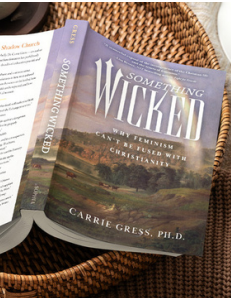
If I could recommend a book to any young female professional, it would be “Something Wicked: Why Feminism Can’t Be Fused with Christianity” by Carrie Gress, Ph.D. The insights she shares about the dangers of feminism are ones that I have spent the last several years untangling as a mid-career professional and full-time, stay-at-home mom. This book would have saved younger me some heartache in terms of how I viewed the working world and myself.
In this bombshell book, Dr. Gress outlines the very shocking and truly diabolical history of the feminist movement, highlighting major feminist leaders and their influence on women’s history today. She begins the book by stating:
“…the glitter of feminism has promised much but is proving to be not only empty but dangerous. Feminism has been presented as just a “women’s rights” movement, serving a good purpose in general by providing women with jobs, education, opportunity and empowerment. But as we dare to pull back its curtain to expose its philosophical roots, we see a much more sinister reality.”
That sinister reality, as readers quickly learn, is cloaked in the fact that feminism is truly a “shadow church” that harms more than it helps, and oppresses more than it liberates.
The book is split into four parts – Building the New Woman, The New Faith, Christian Feminism, and Restoration – with sub-chapters as well. Each chapter could truly evolve into its own separate book and all are loaded with footnotes and suggestions for further reading.
Surprising Origins
It was startling to learn that most, if not all, of the major leaders within the feminist movement experienced some level of abuse and brokenness in their personal lives. This ultimately led them to reject Christianity, which they felt was oppressing women and causing their problems. As with any slippery slope, many of these women began to view men as the enemy, to dive into promiscuity, engage in occult practices, and – in later waves of feminism – become heavily involved in Marxism or the communist movement.
Work as an Idol
One of my favorite chapters to read was “The Sacred Rite: Work,” where Gress exposes the influence of communism on the feminist movement, and what was happening historically and technologically that led to this message falling on fertile ground in the hearts of so many women. In this chapter, she also firmly dismantles the lie that children are a distraction from “more important work,” and that women need to act like men in the workplace to “get ahead.”
She shares beautifully:
“…if we start to encourage women to think of themselves as women, imbibed with maternal instincts and the capacity to care for others, there is a way to integrate women into a professional structure without undermining productivity and career objectives. In fact, it would also be a benefit to the workplace, because mature women, faithful women, typically avoid the negative behavior that can have a stultifying effect on both male and female morale. The key piece for this to happen is for women to know that their career isn’t the most important thing in life; the unique call each of us has is.”
Where Do We Go from Here
Throughout this well-researched and engaging book, Gress makes strong and convincing arguments as to why feminism cannot be fused with Christianity. She does an expert job of painting a realistic picture of the damage that feminism has wreaked on our culture. She also does an effective job of calling women to more, to love the ordinary and to be a warm and safe home for those around them. She reminds mothers that:
“Motherhood offers this same promise, of performing work that has the capacity to last not just for thousands of years, but for eternity: the crafting of an immortal human soul.”
Emboldened by this vision, I found myself yearning for more specifics as to what this restoration of women should look like as I read the final chapter. In it, Gress provides some details about how to reverse the harms of feminism. However, I would love to read a “part two” to this book, or even a “how to” guide to assist women in implementing her vision.
Overall, this is truly a well-researched book and Gress provides a wealth of knowledge on this essential topic. I encourage every Catholic woman to review and discuss it with other women, so that like Gress encourages, we can continue to grow into women who are “safe, grounding, compelling, and fruitful.”
Valentina Imhoff, MBA, is a career coach helping others encounter God through their work. She has lived and worked in six countries and has over 10 years of experience in a variety of industries. In addition to coaching, she facilitates Called & Gifted workshops to help others discern their charisms. Her greatest loves are her husband, son, and trying new recipes in the kitchen. Connect with Valentina at fiatcareercoaching.com, or tune into her podcast on YouTube, Apple Podcasts, or Spotify.