

Three Reasons to Get Standard First Aid and CPR Certified
“Human life is sacred because from its beginning it involves the creative action of God and it remains forever in a special relationship with the Creator, who is its sole end” (Catechism of the Catholic Church, 2258).
Editor's Note: June 1 through 7, 2026, is National CPR and AED Awareness Week. Learn more from the American Heart Association.
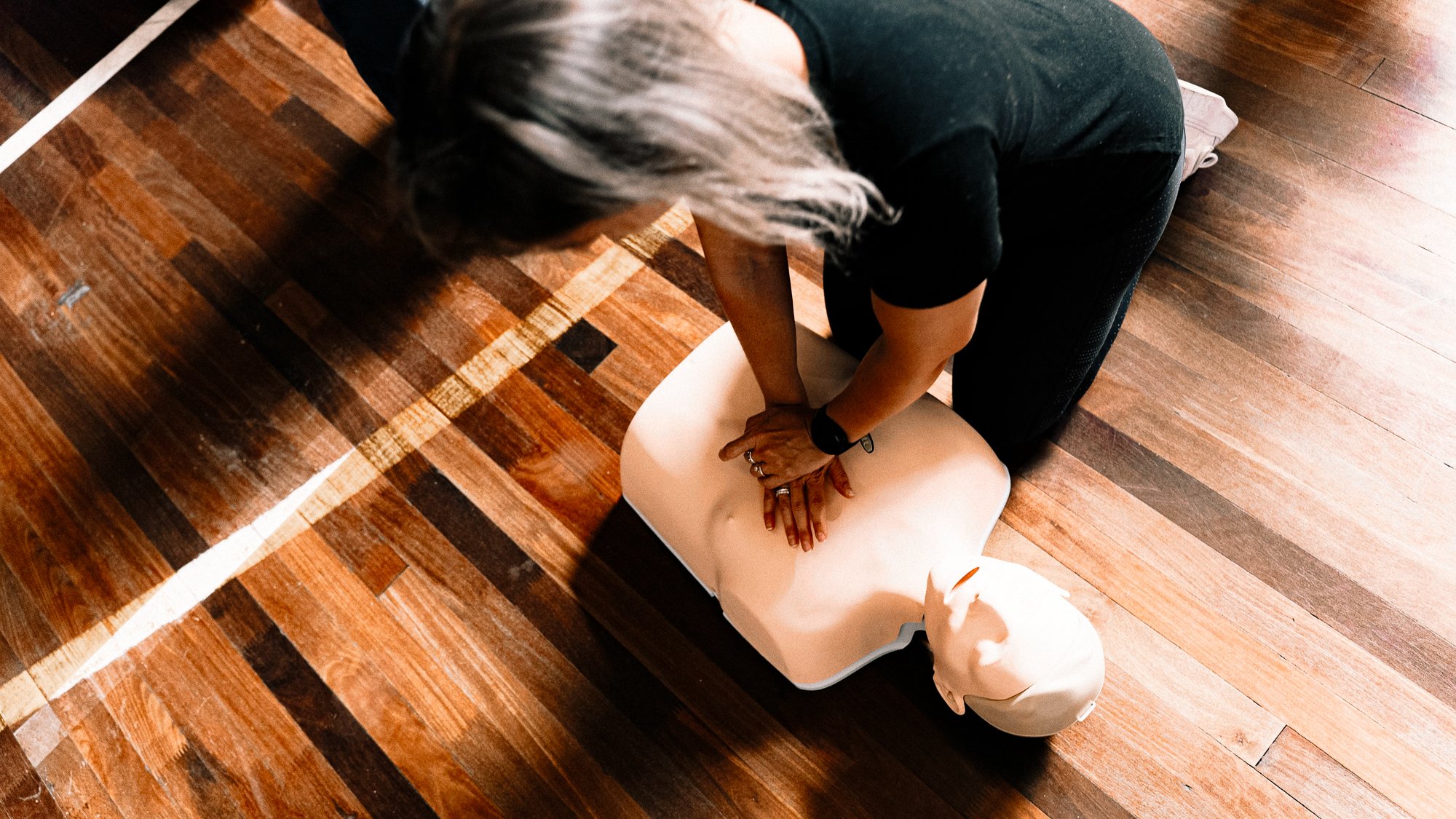
Recently, my husband and I took a two-day Standard First Aid and CPR class offered in our neighborhood by a not-for-profit corporation. We learned an impressive range of topics, such as how to assess and care for bruises, sprains or fractures, burns and heat stroke, hypothermia and frostbite, mental health emergencies, and anaphylactic shock (severe allergic reaction). We also learned and gained practical experience (on demonstration mannequins) in performing cardiopulmonary resuscitation (CPR) and using an automatic external defibrillator (AED) machine (often available in public places). These are life-saving procedures to help a person who is unresponsive and not breathing, which could mean the difference between life and death while waiting for emergency services to arrive on the scene.
An aspect of my in-person course that I particularly appreciated was the role-play and practical activities (with the assistance of demonstration mannequins; no course participant was ever put in danger). We put our theoretical lessons to the test in situations where we had to assess and provide simulated care for different medical emergency scenarios.
Our instructor (who had accumulated more than 20 years of first aid experience as a paramedic) shared his passion for saving lives with us and gave us practical advice from his own experiences out in the field. Now, we are not all called to be health care providers, such as paramedics, nurses, or doctors. However, why not equip ourselves with the skills that may just save a life one day while waiting for emergency services to arrive? If you have not already done so 一 or it has been many years since you were certified 一 here are three reasons why you should consider getting your Standard First Aid and CPR certification.
1. For your family
In the course, we learned that 70 percent of medical emergencies happen at home. This statistic implies that if we are placed in a situation where we need to use our first aid knowledge, it could likely be to provide care for a loved one. Meanwhile, ensure you have a basic first-aid kit at home and, if you have one, in your vehicle.
2. For your workplace and community
Some jobs require a certain level of first aid training, particularly those involving regular interactions with vulnerable groups, such as children or the elderly. Emergencies can happen suddenly to anyone, anywhere: on the way to work, out on a hike in a park, or shopping at the mall. Educating ourselves in first aid is one way we can equip ourselves with the knowledge to help others in our community.
3. For your education and empowerment
Knowledge empowers us in difficult situations. During a medical emergency, these skills can reduce anxiety and stress. The key is to do what you were trained to do, assuming that it is safe to approach the scene.
First Aid certification is typically valid for three years, after which you may renew your training through a (shorter) refresher class where any updates to recommended procedures will also be conveyed.
Various organizations offer training in First Aid and CPR. Are two full-day, in-class lessons not feasible for you right now? Look into whether hybrid options are available. You could also consider alternative (i.e., shorter) courses that focus on the essentials, such as a half-day or one-day Emergency First Aid and/or CPR course.
"Life and physical health are precious gifts entrusted to us by God. We must take reasonable care of them, taking into account the needs of others and the common good." (Catechism of the Catholic Church 2288)
Sarah Gagliano Taliun is a genetics professor with many interests in addition to studying DNA. She and her husband now call Montreal home. When she is not reading a scientific article or meeting with students, Sarah can be found experimenting with new recipes in the kitchen, reading her Bible, or taking a walk in nature.