Using AI as a Designer and Business Owner
“For we are his handiwork, created in Christ Jesus for the good works that God has prepared in advance, that we should live in them” (Ephesians 2:10).
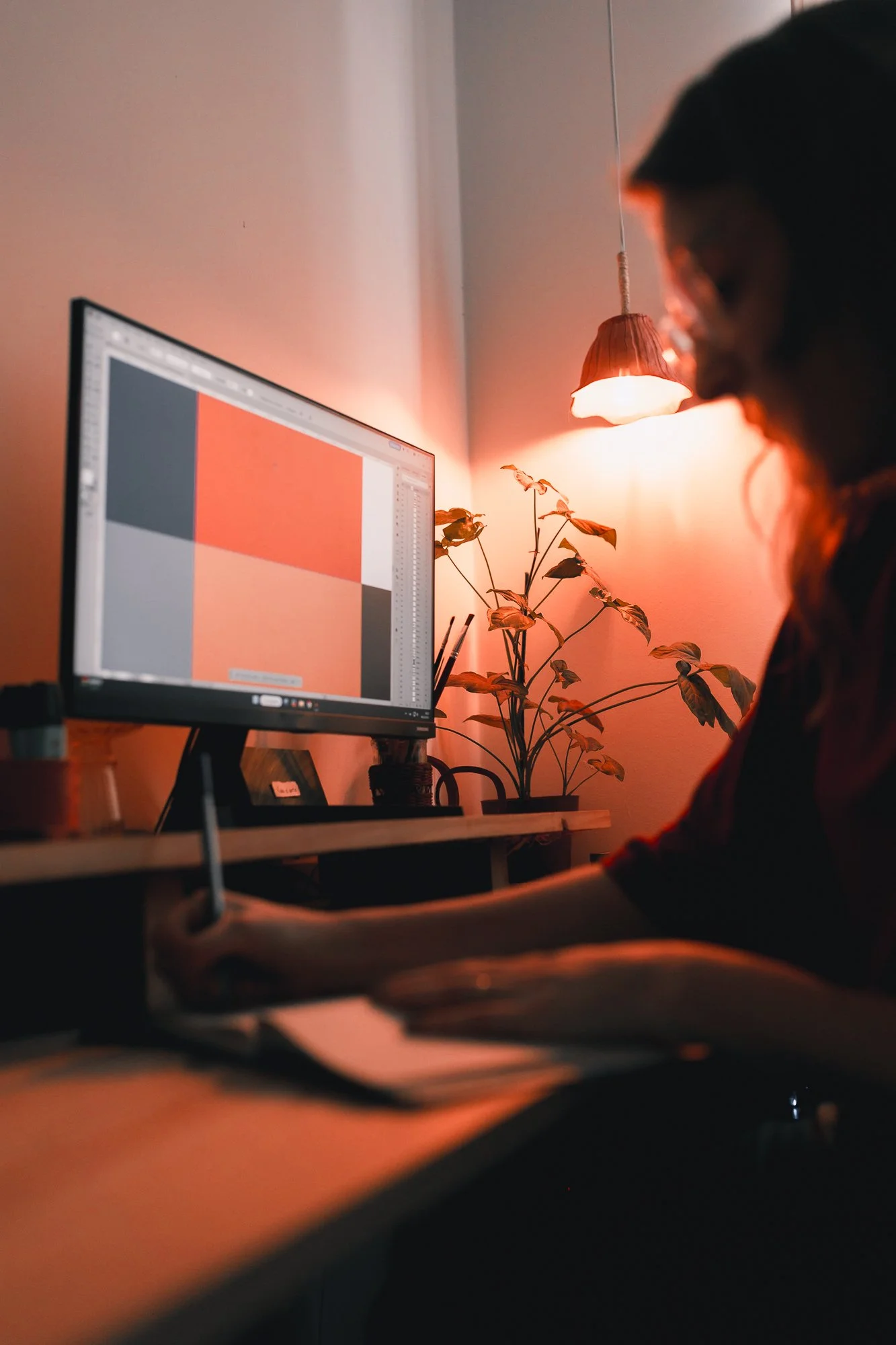
Whether you choose to use it or not, artificial intelligence, or AI, is becoming an increasingly more pervasive part of our everyday lives, in all industries, and especially in design. As a designer and business owner, I’m currently grappling with both the challenges and the benefits from AI being used in my line of work. It’s a constant, giant question mark that hangs over my head: Should I use AI or not? If so, how do I do so with integrity?
Honestly, I don’t have all the answers. What I’ve decided for myself and my business is to use it as a tool, and be as careful as possible in my use of it by following our church’s guidance as my north star. Pope Leo gave us the Magnifica Humanitas, and while it’s not exactly a manual on precisely what to do and what not to do with AI, we can follow it as a guidebook on how to use it with integrity and in alignment with our Christian values.
The core of how I approach AI in alignment with the Church is by asking myself some specific questions when I use it. For me, these apply to a design-specific context, but I think these are useful questions for anyone in any industry:
Is the task that I’m asking AI to do something that I have the means and resources to hire a human to do instead?
Am I forgoing real, interpersonal connection by using AI, rather than trying to reach out to someone for guidance, help, or collaboration?
Am I using AI rather than thinking for myself? If so, why?
How do I remove the barriers that are holding me back from thinking deeply and critically?
Am I relying on AI to do things that the Lord gave me the unique ability to do?
Is the task that I’m asking AI to do something that I have the means and resources to hire a human to do instead?
With AI being a relatively new tool (it’s been around for awhile, but its usage is more widespread than ever before), there are many gray areas. It can be tempting to rely on ChatGPT instead of other human beings.
For instance, I’m not an operations expert. Since starting my business, I’ve needed to figure out so much about systems and processes on my own. When time equals money as a business owner, the faster I can figure something out, the faster I can implement it and operate my business more smoothly. So I’ve relied on ChatGPT to help me develop those systems and processes, freeing up more time for me to be creative and focus on design work.
The thing is, I could hire someone to do these tasks and figure out these things for me. But while I’m still in a relatively “start up” season with limited resources, hiring isn’t a practical option for me. Do I plan to continue to operate in this way though? No. I see an opportunity to eventually hire someone when I do have the means – a human who can bring a real brain who can understand my clients and my business deeply.
As a designer, I struggle with reconciling my use of AI for creative work with the worry that I’m cutting corners, or even being a hypocrite. I sometimes use Midjourney for imagery, mockups, and video. Again, I’d love to have the money and time to hire a full team and art direct a full photoshoot, and I will one day. Right now, though, a $10 subscription is honestly more time- and cost-effective. I also at times have some really specific, out-there ideas that legitimately would be very difficult to achieve through photography, or would take hours (that I just don’t have) to try creating in Illustrator, Photoshop, etc. So why not use a tool that can create that vision nearly instantly?
Additionally, we can also stay at the forefront of our industry by learning how to use AI more effectively for our own creative work, and distinguish our creations from the occasional or untrained user. Similar to when Canva emerged in the market about 13 years ago, designers like me balked at the app while worrying it was going to take over our jobs. Well, Canva and I are still in the creative business, and ironically, I use Canva almost daily! It’s simply become another tool in my toolbelt.
In that respect, should I judge those who use AI to create logos for them? Or websites? I try not to judge anyone on anything, but it’s hard to avoid this when the direct impact of those uses affects my livelihood. Which brings me to my next point…
Am I forgoing real, interpersonal connection by using AI, rather than trying to reach out to someone for guidance, help, or collaboration?
Ironically, while I’m using AI to complete some specific tasks in my business, the biggest issue that designers and creatives like myself are facing with AI is the prospect of it taking over our jobs. Current and potential clients forgo hiring a human designer or artist to create for them. While I of course don’t love that this is the reality of our industry today, I see it as a call to challenge ourselves. Designers like me need to get even better at our craft to further differentiate our work from that of technology. We have an opportunity to more clearly position ourselves as deeply thoughtful humans who have the feelings, connections and experiences that make our work uniquely representative of the human experience.
“So-called artificial intelligences do not undergo experiences, do not possess a body, do not feel joy or pain, do not mature through relationships and do not know from within what love, work, friendship or responsibility mean,” Pope Leo said in Magnifica Humanitas. It’s those human emotions, experiences, institutional knowledge, and skills that allow designers like myself to create fresh and original work for our clients. Personally, as objective as I try to be, I’m still putting a part of myself into each creation; I may combine styles and artists I’m influenced by, or draw inspiration from my own knowledge and personal experiences.
Interpersonal connection is also a crucial part of the design process, and that’s something AI can’t replicate. I try to understand each client’s vision for their business, their values, their mission, and their dreams in order to create something that represents them. AI does have an increasing ability to understand an individual or business, but it’s not truly bringing any of the empathy and personal connection that humans can.
That deep personal connection – however much can be achieved through the course of a project – also provides context. While we can feed AI a lot of context, there’s always going to be something missing. Human beings see details about life in unique ways, and designers are especially attuned to spotting inspiration in what may seem like random places.
For example, I have a client who is an aesthetician. She initially used ChatGPT to create her logo based on the idea of referencing a flower and St. Thérèse of Lisieux. It generated an overly simplistic icon of a flower and added her business’ name to it – it wasn’t bad, but it wasn’t good. Yet, she knew that her business deserved something much better. So when we partnered to work on redoing her brand, I pulled her inspirations, used a combination of feminine, illustrative, and Art Nouveau styles, and created a unique logo for her that symbolizes her whole ethos and sets her apart from other skincare studios.
That leads to another issue that makes AI problematic with design: it pulls from what already exists on the internet. Even if it does create a beautiful design, it’s still derivative. AI-built designs run the risk of being unoriginal – or, worse, a copyright infringement.One of the reasons why branding exists – and why people pay for someone to do it – is because they want to stand out! I see this as another challenge for those of us who are brand designers: We must hone our skills and individual style in order to clearly differentiate ourselves from what lines of code can simply generate.
Am I using AI rather than thinking for myself? If so, why?
One use of AI that I’ve found especially helpful as a designer is its ability to cull the vast reaches of the internet and pull tons of information for me. Part of my process as a designer is to research industries, products or topics in order to more deeply understand a client’s line of work before diving into design. AI helps me collect and distill research much more quickly and efficiently than I could before. Then I use my own critical thinking skills to decide what information to use as inspiration or strategy. I believe this aligns with a principled use of AI because I’m using it as a tool to hasten the efficiency of a process that I normally do, which ultimately saves me time, energy, and money.
Pope Leo also expressed his concern about the erosion of critical thinking skills; namely in those of children and students. I also see how that affects grown adults who are overrelying on AI to think for them. I admit, I’ve been guilty of this myself by asking AI to help me draft an email, or prompting it to write an intro for a proposal. I realized this was becoming a bad habit, though, and have recently started to ask myself the next question.
How do I remove the barriers that are holding me back from fully thinking deeply and critically?
We have to ask ourselves: Why am I resorting to using a machine for these simple tasks? There are myriad reasons why, whether we’re feeling like we’re in a rush to get something done, or we’re tired and have no more energy to tackle a mental task.Perhaps we’re afraid of actually using our own voices and not sounding like what we think we should sound like.
That’s where we need to dig to the actual root of the problem. How can we change a situation to allow ourselves to work more as humans, and less as machines? The design process, for example, isn’t often linear, nor is it transactional. Designers will brainstorm, sketch multiple times, and go through several iterations of a single logo. It’s a messy, but beautiful process of exploration and discovery. Resorting to using AI to generate a logo takes away the chance for a designer’s brain to operate at its fullest potential.
Am I relying on AI to do things that the Lord gave me the unique ability to do?
As described above, design at its core is an act of creation. And AI can’t create. It can’t invent something completely new that hasn’t existed before. Humans – made in the image and likeness of God – are uniquely blessed with this ability. It’s existed throughout all of human history, well before computers came along. Even if you don’t consider yourself creative, as a child of God, don’t you want to fulfill the gifts He’s given you? AI can be used as a tool or supplement to your own work, but it shouldn’t replace your ability to live out your vocation.
So…should I use AI, or not?
AI is an incredibly nuanced issue, especially for creatives like myself. I don’t believe there’s a clear answer on whether or not to use it, and if you do use it, how to do it “right.” Like any decision we make in life, we have to hold it up to our values as Catholics and as children of God. It’s a near-daily debate for me, any time I open Midjourney or ChatGPT, to determine if my use is right by what God wants. I run through the questions that I’ve shared here, and then decide. With this constantly-evolving technology, I pray that these questions help you too.
Lisa Johnson is the Founder and Designer of Verve & Concord, a branding and design studio that helps Catholic female founders tell their brand stories, and the Creative Director of Catholic Women in Business. Her previous experience includes creating brands and designing digital, print and experiential materials for nonprofits and associations. Lisa is an alumna of the University of Florida. She still considers herself a Floridian despite being a Washington, DC resident for 15 years and counting, where she lives with her husband and son.
Connect with Lisa: