

"He knows each one from all eternity, with all the mysteries of her being, and every wave that breaks over her life," St. Edith Stein.
It was no mistake that St. Edith Stein lived when she did, where she did, or for Whom she did. Nor was it mere chance that she encountered devout Christians along the way who bore witness to Christ's love for her, drawing her forth from the darkness of unbelief to the truth and light of Jesus Christ who shows us who we are in Him.
A Jewish convert to Catholicism, Edith Stein became a luminous Christian witness to her contemporaries during the dark reign of Naziism in Germany, first as a philosopher and teacher, then as a Carmelite nun, Sr. Teresa Benedicta of the Cross, and ultimately, as a martyr killed by the Nazis for her Catholic faith. By saying yes over and over again to greater conformity with Truth and Love Himself, Edith Stein became fully herself, an image of Christ only she could manifest.
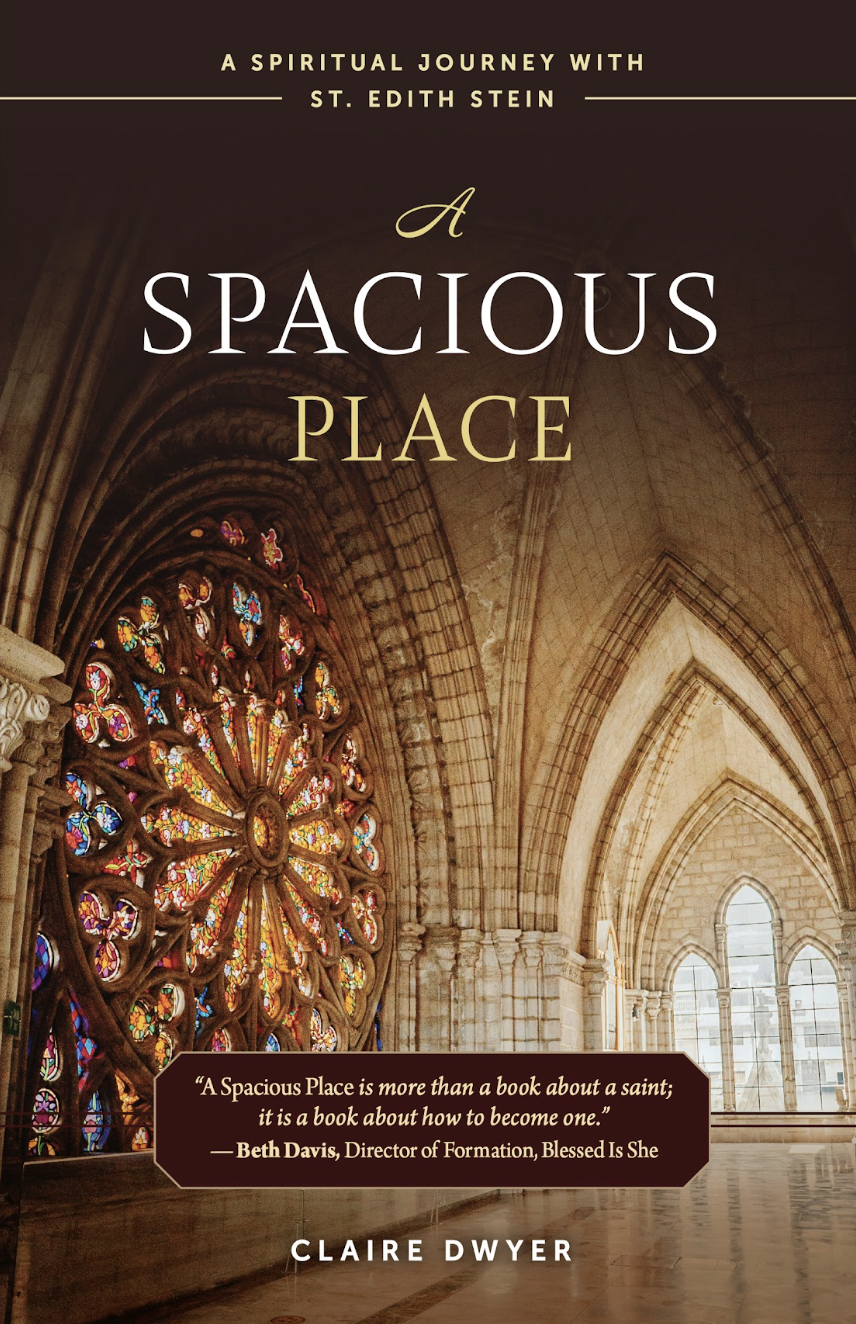
In her newest book, A Spacious Place: A Spiritual Journey with Edith Stein, Claire Dwyer introduces Edith Stein to us as only she can. The book is the delightful and edifying fruit of careful research and reflection on Edith Stein's life and writings. Dwyer employs her gifts as a wordsmith and storyteller, as well as her gift of discernment, to lead readers on a meditative pilgrimage through the gripping tale of Stein's fascinating life. She draws from the deep well of Stein’s wisdom and scholarship to reflect on a myriad of profound questions including:
How to discern God's will and purpose for our lives.
How to practice abandonment to Divine Providence when the path forward seems completely dark.
How to be patient when we cannot yet make a change we already believe to be God's will for us.
Why love and truth are inseparable.
What it means to become fully the woman God made us to be through conformity with Christ.
How to discover our individual purpose and unrepeatable vocation in salvation history.
Ordered both chronologically and thematically, Dwyer illustrates Stein's family life, education, conversion, professional, and religious life, and her ever-deepening encounter with Christ that culminated in the crown of martyrdom. A few of the major themes explored in the book are conversion, discerning God's will, and understanding our identity and — for women, especially —our feminine nature in light of Christ.
As a Catholic school teacher of young women, the proper development of the feminine soul was of special interest to Stein, both in terms of building upon natural feminine strengths and virtues and rooting out our vices and sinful proclivities. Of course, before she could teach other women how to be more fully themselves in Christ, Stein opened herself to the transformation Christ wished to work in her, thus making her soul an inviting, well-ordered sanctuary where others could encounter Christ dwelling. For instance, though she was critical and perhaps somewhat prideful and condescending prior to her conversion, she became extremely gracious, kind, and uplifting afterward. She humbly and gently assisted her students and peers in rooting out vice and becoming more Christlike.
Once she had made a considerable ascent up the mountain of conversion, Stein's peace and charity were palpable to those she encountered. To illustrate this, Dwyer relays the admiring words of one her beloved students:
Fräulein Doktor was a personality, a human being in the fullest sense, nothing stunted or twisted. Her natural, moral, and religious endowments had all been integrated in complete harmony...Her heart stood wide open for everything noble and beautiful to take its place beside her union with God.
To become such a soul is the goal of the Christian life!
If the purpose of life is to know, love, and serve God, and to become more fully ourselves in and through Him, the pilgrimage through “A Spacious Place” is a very worthwhile use of our limited time. What gives us the courage to die to ourselves, abandon ourselves to God's provision, and become fully ourselves, even when the process of sanctification involves deep suffering? Echoing concepts expressed by Stein, Dwyer explains: "When we know we are loved and delighted in, we become free to become more ourselves."
As a fellow phenomenologist and contemporary of Stein, Dietrich von Hildebrand said: "The saints do die to themselves, in the sense of being absorbed by their love of Christ, losing themselves in Christ, and only thus do they find their true selfhood — their self as intended by God.
Deeply grounded in this understanding that conformity to Christ is key to self-discovery, Stein offers indispensable wisdom about the nature of a woman's soul and how every woman can find her purpose and identity in Jesus Christ. Dwyer beautifully synthesizes Stein’s wisdom:
The soul of a woman growing in the likeness of Christ signals that she is self-possessed, which means she has mastery of her impulses, emotions, and desires. She has ordered them all under Jesus. She is not controlled by her lower nature but has put all at the service of higher things. There is One ruler in her kingdom; she has cast aside all other crowns.
This kind of woman is responsive but not reactive, available but not irresponsible, not blown about by storms or the stirrings-up of the enemy. Her self-possession is not an end in itself; it is so that she can make a greater gift of herself.
Indeed, following her conversion to Catholicism, Stein displayed the remarkable self-possession of a well-ordered soul, an expansive soul that has welcomed Christ and could welcome others too. The peace and charity that is only possible with Christ emanated from her to her students, peers, and even to her fellow victims as they were transported to their deaths at Auschwitz.
Through worldly eyes, Edith's story is deeply tragic, the story of a life in full bloom cut short by demonic hatred and merciless injustice, like a radiant, blossoming flower cut from its roots, only to be cast down upon the ground to wither and die. From a Christian perspective, we see the victory was not her persecutors' and Satan's, but hers and Christ's. By her sacrifice and witness she participated mystically in Christ's perfect sacrifice on the Cross. United with Christ's redemptive suffering, Edith Stein's life was given for the salvation of souls, of the Jewish people, of Germany, and of the entire world.
St. Edith Stein, pray for us!
Katherine is a mother of four and lives in Virginia with her family. She contributed a chapter about Our Lady Undoer of Knots to Crowned with Grace: A Collection of Marian Titles and Devotions and a chapter about intercessory prayer to the forthcoming book, All Blessings Flow: Stories of God’s Provision and Providence.
She holds a Bachelor of Arts in politics from Ave Maria University. Prior to her current role as homemaker and home educator, she served as communications director for the National Center on Sexual Exploitation, Cong. Keith Rothfus, and Heritage Action for America. She is passionate about living out her Catholic faith and fostering a culture that protects children’s innocence and joy.