

Book Review: “The Song of the Lamb”
And they sang the song of Moses, the servant of God, and the song of the Lamb: “Great and wonderful are your works, Lord God almighty. Just and true are your ways, O king of the nations” (Revelation 15:3).
Having spent much of my career so far as a musician, I can’t help but be deeply attuned to music in any setting. Particularly in the Mass, where music is such a foundational element of worship, I find that music can have a deep impact on my experience of the liturgy. While one can walk into any Catholic church and the Order of the Mass remains the same, the same cannot be said of the music. With such a variety of musical genres, skill levels, and instrumentation, it can often feel like there is a lack of direction or clarity about what liturgical music really is.
Defining Liturgical Music
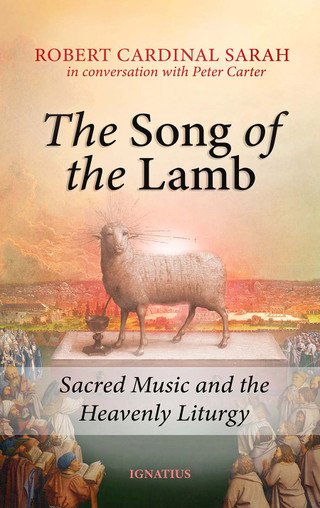
In “The Song of the Lamb: Sacred Music and the Heavenly Liturgy,” Robert Cardinal Sarah, in conversation with Peter Carter, delves into a thorough examination of the part that music plays in the liturgy. Although not widely known, there are multiple Church documents that have been written – especially during the 20th Century – that define liturgical music and its role. Throughout the book, Cardinal Sarah draws on these documents to build a picture of what sacred music is and what it is not, which is of particular interest to those wishing to learn more about what the Church teaches in this regard.
The 1903 document Tra Le Sollecitudini outlines the three criteria of sacred music as Sanctity, Goodness of Form, and Universality. In Cardinal Sarah’s explanation of these points, the reader will gain a better understanding of why not all music is appropriate for liturgy. Ultimately, liturgical music is not about how it makes us feel, but rather that it gives glory to God: “There is a real danger in reducing the liturgy to a mere feel-good experience, as if the Church were offering a spiritual palliative on Sunday mornings.”
Cardinal Sarah explains how, although we may find certain styles of music comforting because of their familiarity in our culture, this is not the purpose of liturgical music. Rather, liturgical music should turn our focus to God and spiritual life.
Liturgical Music in Practice
Cardinal Sarah also offers insight into certain elements of the liturgy and their intersection with music, particularly areas that often involve some level of confusion and even contention in the Church today. These include a deeper discussion of the role of Latin in the Church, what is meant by inculturation, and to what degree it can be incorporated in the liturgy, congregational participation in liturgical music, and evangelization.
The topic of congregational participation is explored in depth, and Cardinal Sarah highlights that participation need not always be verbal; it can also be contemplative, harkening back to his book “The Power of Silence.” As a musician, I wryly appreciated the inclusion of this quote from then Cardinal Ratzinger: “Should we absolutely force those who cannot sing to sing, thus silencing their hearts and those of others?” Cardinal Sarah highlights how participation in liturgical music can look quite different from what we imagine and can be practiced by all, even those who are not musically inclined.
Of particular interest is the discussion of music as a means of evangelization. While he notes that “liturgy is first and foremost for praising God, not as a tool for evangelization…however, the beauty of the liturgy certainly leads people to discover God, and in this sense is a form of evangelization, although that is not its primary purpose.” Thus, in preserving and upholding true beauty in the liturgy, including through music, others may come to know and worship God. This is a truly noble mission for those serving the Church in a musical capacity.
The Path Forward
In reading “The Song of the Lamb,” it becomes clear there is much that can be done to ensure that liturgical music is an expression of true beauty, inspiring the congregation to deeper prayer and closer union with God, but Cardinal Sarah traces a path forward. He emphasizes the role of parishes and church music directors in fostering a love of music through choirs and music formation, and highlights the importance of sharing one's talents. He also discusses the importance of the Divine Office (often referred to nowadays as the Liturgy of the Hours) as a main form of communal liturgical prayer, alongside the Mass. While the prayers of the Office are often recited, they were traditionally sung; and fostering this tradition, especially as a public form of worship, can serve as another means of revitalizing liturgical music.
Overall, “The Song of the Lamb” examines the Church’s teachings on liturgical music, offers a thorough examination of the current state of liturgical music, and provides a plan for better aligning the two. Although this is not a straightforward or easy process, Cardinal Sarah reminds us that “we must not allow our personal opinions and tastes to distract us from the heart of the matter: the mystical encounter with Christ. Let us keep our eyes fixed on Him, allowing His grace to transform us from within.”
Whether one is a musician or not, “The Song of the Lamb” is an essential read for anyone interested in learning more about the role of music in the Church.
Laura Henry works in marketing as a project manager and serves as the project manager for Catholic Women in Business. After spending a decade as a private voice and piano instructor, she continues to actively participate in music whenever possible. Her educational background includes an MBA and a BA in music, reflecting her dual passion for business and the arts.