

How to Get Ahead in the Age of AI
“Blessed are those who trust in the LORD… They are like a tree planted beside the waters… It does not fear heat when it comes, its leaves stay green; In the year of drought it shows no distress, but still produces fruit.” (Jeremiah 17:7-8).
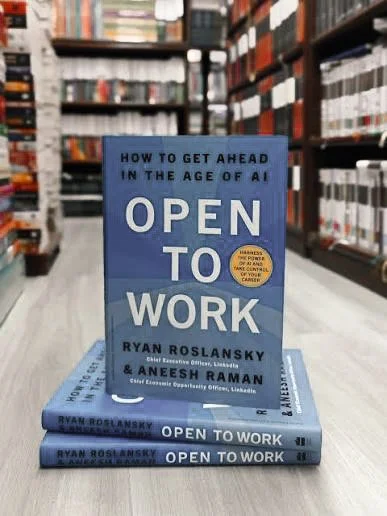
The newly published book, “Open to Work: How to Get Ahead in the Age of AI,” by Ryan Roslansky, the Chief Executive Officer of LinkedIn and Aneesh Raman, the Chief Economic Opportunity Officer of LinkedIn, can be summed up with three words: lead with humanness.
As the world grapples with the pros and cons of Artificial Intelligence (AI), Roslansky and Raman earnestly remind readers that our human capacity to love, empathize and innovate are superpowers that can never be replaced by AI. They reassure readers that it is biological to fear what we do not know and understand. However, they explain that the goal is not to beat that fear, but instead to “act despite it.”
The authors begin with a story about the Apollo 13 Space Mission, which required the innovation and adaptability of the space and land crew to bring the astronauts safely home. In a critical life and death situation, it was the crew’s ability to act despite uncertainty that determined the overall outcome. “It proved that in moments of existential crisis, the choice isn’t between success and failure; it’s between action and paralysis. It’s between solving the problem or staring at it.” -xvii
A Hopeful Future
The book is peppered with stories of entrepreneurs and business people who acted despite the uncertainty of AI and used it to build new businesses or improve operations at their company. They share that AI is a great equalizer of economic opportunity, as it provides tools of innovation for everyone. Additionally, it can help find the “Lost Einsteins,” the ones who “would have delivered significant inventions had the system recognized their potential and supported their rise.”
Roslansky and Raman also distinguish that “AI is coming for tasks, not people.” They encourage readers to look at their work not based on their job title, but instead as a series of tasks that they do. From there they can begin to categorize which tasks they can offload to AI, which tasks they can partner with AI, and which tasks are uniquely human that cannot be done with AI.
They explain that job security will be found in partnering more with AI and crafting a role that relies more on soft skills than technical skills. “As AI commoditizes technical skills, your edge lies in your singular experiences, unique judgment, empathy, resilience, and problem-solving. Machines can replicate tasks, but they can’t replicate you.” (pg. 145)
The Five C’s
Roslansky and Raman propose five capabilities that AI cannot replicate and that everyone should work to develop. Those are: curiosity, courage, creativity, compassion, and communication. They explain:
Curiosity: AI can process patterns, but only humans can ask, “What if we tried something completely different?”
Courage: AI can calculate risk, but only humans can decide which risk is worth taking.
Creativity: AI can remix what exists, but only humans can reimagine what is possible.
Compassion:AI can simulate concern, but only humans feel it and express it.
Communication: AI can translate language, but only humans can turn language into meaning.
Some Cautions
The authors do an effective job of lowering the mental barrier to incorporating AI in one’s work. The book is well-researched with many studies indicating that workers who use AI say that it helps them save time (90%), focus on their most important work (85%), be more creative (84%), and enjoy their work more (83%). (pg. 78)
However, very little space is spent exploring the real concerns with relying on AI, beyond the research on cognitive debt, which states that “when we outsource our thinking entirely to AI, we don’t just get worse outcomes; we actually degrade our own ability to think critically.” (pg 31)
Additionally, in the race for optimizing our work, the authors miss a critical point made by Pope Leo XIV in his encyclical titled Magnifica Humanitas — that we cannot allow a focus on efficiency and optimization to overlook the redemptive nature of suffering. Also, as Catholic women in business, although we are called to work to the best of our ability, our worth is not and should not be determined by the sum of our productivity.
At the end of the book, the authors include a 30-60-90-day plan to help readers increase their proficiency in AI tools and reenvision their careers. Each section includes questions to consider and exercises to do each month. Days 61 to 90 are focused on transforming your career and discovering why you work, what you uniquely do and where you are going. Although a very useful and concrete framework, the primary focus is on self-reflection and discerning ones’ own passion and desires.
However, it is worth noting that there is a danger in such self-focus. In the encyclical, Christus Vivit, Pope Francis cautions young people who are discerning their personal vocation, saying that:
These questions should be centred less on ourselves and our own inclinations, but on others, so that our discernment leads us to see our life in relation to their lives. … “So often in life, we waste time asking ourselves: ‘Who am I?’ You can keep asking, ‘Who am I?’ for the rest of your lives. But the real question is: ‘For whom am I?’’ Of course, you are for God. But he has decided that you should also be for others, and he has given you many qualities, inclinations, gifts and charisms that are not for you, but to share with those around you (286).
With Christ and others in mind, this book is ideal for anyone wondering how AI will impact their work and who is struggling to embrace it. Reading it will help reduce any apprehension, and to reframe it as another tool in one’s professional toolbox.
Valentina Imhoff, MBA, is a career coach helping others encounter God through their work. She has lived and worked in six countries and has over 10 years of experience in a variety of industries. In addition to coaching, she facilitates Called & Gifted workshops to help others discern their charisms. Her greatest loves are her husband, son, and trying new recipes in the kitchen. Connect with Valentina at fiatcareercoaching.com, or tune into her podcast on YouTube, Apple Podcasts, or Spotify.